Hoping to avoid spoilers, but read at your own risk.
The moment The Avengers was announced, I knew I was going to it. A movie with Iron Man, the Hulk, Thor, and Captain America? How could I not? But at the same time, I was a little leery because the film would have a lot of strong, well-loved characters who'd demand screen time and I haven't seen all that many superhero ensemble films-- The Fantastic Four comes to mind, and that was abysmal.
I was glad to hear that Joss Whedon would be helming the film, though. I'm not a massive Whedon fan, but I've enjoyed his work and trust his writing and directing, and I know he's a geek and a fanboy. I figured he'd do the movie and characters justice, if anyone would.
I was torn by the trailers. They did a great job of inspiring confidence that the film would look awesome and treat the characters appropriately, and they were wonderful at conveying the general mood and plot without actually giving details. But at the same time, they had Thor fighting other Avengers, didn't show very much of the Hulk, gave the impression that there wouldn't be much substance (just battles), and had some valid complaints lobbed at it re: the fact that Black Widow has a tiny gun. I also wasn't sure how I felt about not entirely knowing the villain ahead of time.
The movie is and isn't anything like the trailers. We get the awesome battles and the snark, but we also get a tight, thinking-person story that keeps you guessing, and strong and believable character dynamics. It's just as thrilling and inspiring of nerdy glee as you'd expect. The science looked and sounded plausible. One of my bigger worries was that the Avengers would be introduced in a single scene, but I shouldn't have: Whedon spread the characters out so we'd get to know them one by one, and did it in such a way that the introductions worked with the story, rather than feeling forced. There were some excellent gags that had everyone in the theatre laughing. And Whedon even managed to bring out the personalities of lesser Marvel movie-verse characters Hawkeye and Black Widow, and to make me want an origin movie for the two of them. While there wasn't a whole lot of character arc material, there was some, and I definitely like Ruffalo's portrayal of the Hulk (though I haven't seen the other recentish Hulk movies).
One thing I've been noticing more lately is the appearances and agency of women in fiction. I blame the internet. Whedon did a good job, in my unschooled-in-formal-feminist-criticism opinion—that one line that has online feminist fandom talking aside. Natasha Romanov/Black Widow comes off as a realistic woman, with friends and fears and a fantastic ability to beat people up. She has action and agency and isn't a sexual object. Maria Hill is equally awesome, though we get less of her personality and more of her second-in-commandness. I don't remember anyone treating her differently because of her sex. And there are bit parts that could easily have gone to men, but went to women, which was nice to see. The Avengers doesn't pass the Bechdel Test, but that's not the be-all-and-end-all of feminist critique for me.
A couple quibbles: Fury was great, but largely in the background (which is probably fine, it's The Avengers not Nick Fury). We saw him making decisions and saying they were right, without any proof he could make good calls, but that might've taken away some of the suspense, so that's fine with me in the end too. Still, Fury's an interesting character and I'd like him to look less like a figurehead.
I also felt that Loki was a little out of character with his scheme, but believable enough. I had more trouble with him willingly subordinating himself to another person. Loki definitely makes a good villain, though, and I hope to see more of him in other films. He plays long games and keeps people guessing, and I like that.
Quibbles aside, I really liked the film. Spent-2.5-hours-in-a-theatre-grinning-my-head-off liked the film.Going-to-see-it-a-second-time-on-the-big-screen liked the film, which doesn't happen very often. It's fun, it has action and explosions, it has superheroes and some of my favourite characters to boot, and it has plot! That doesn't strictly follow the origin story model! That I couldn't predict!
Go see it, if you haven't already. Or see it again, if you have.
Showing posts with label research. Show all posts
Showing posts with label research. Show all posts
Monday, May 14, 2012


Monday, March 12, 2012
Great Superhero Read - Powers, Vol. 1
I first heard about Powers about a year ago, when it was optioned for TV. It looked like a cool series and I'd heard the author, Brian Michael Bendis, was fantastic, so I did some poking around for reviews then put it on my wishlist. I got the first omnibus for Christmas. I read it a month ago. I liked it enough to keep reading the series when the mood strikes me, but not quite enough to buy more volumes. This may not be the same for all readers, because I'm a) picky and b) cheap, and because this is without question a well-written story.
Powers Vol. 1 ("Who Killed Retro Girl?") is an enjoyable police procedural done in the noir vein. There's lots of swearing, lots of "telling it like it is", and lots of shadows. Someone's killed Retro Girl at an elementary school, and veteran Det. Christian Walker and newly-transferred Det. Deena Pilgrim, of the homicide squad for superheroes, are put on the case. The detecting itself will be familiar to anyone who watches crime dramas--they talk to superheroic contacts, they rule out a couple suspects, they're at wits' end, they have an epiphany--but I'm fine with that for two reasons.
The world is a little less engaging and realized than the cast, but never enough to lose me. In this volume, it's pretty much the backdrop to the characters and the mystery, though we're given tantalizing hints about the history, characters, power balance, and so on. Think of it like the pilot episode of a TV show, unintroduced secondary characters and all. Unfortunately, I think Bendis tried to put too much into this first book, because there are points where it feels like he's glossing over info and name-checking characters. I'd have liked for him to have slowed down a bit.
The world-building issues aren't a big deal, though. I've read books that are far worse on that count. My biggest problem with Powers is that the solution to the mystery comes out of nowhere. The murderer isn't seeded throughout the story like I've come to expect from mysteries. Maybe leaving him out was part of the realism? But it left me feeling vaguely disappointed and is one of the reasons why I'm not going to be buying Volume 2.
Long story short: Enjoyed the story, found it well-written in some areas and competent in others, thought it was a good start to the series. The flaws were largely ignorable. I can see why they want to make a TV show of it, because it would be awesome. I hope it leaves development hell.
Powers Vol. 1 ("Who Killed Retro Girl?") is an enjoyable police procedural done in the noir vein. There's lots of swearing, lots of "telling it like it is", and lots of shadows. Someone's killed Retro Girl at an elementary school, and veteran Det. Christian Walker and newly-transferred Det. Deena Pilgrim, of the homicide squad for superheroes, are put on the case. The detecting itself will be familiar to anyone who watches crime dramas--they talk to superheroic contacts, they rule out a couple suspects, they're at wits' end, they have an epiphany--but I'm fine with that for two reasons.
- This is the first volume and storyline of a serial comic. It's meant more to establish world and characters than to provide a complex story, and it definitely accomplishes the former.
- I still found the story well-written and captivating (except for one thing, but I'll get to that).
The world is a little less engaging and realized than the cast, but never enough to lose me. In this volume, it's pretty much the backdrop to the characters and the mystery, though we're given tantalizing hints about the history, characters, power balance, and so on. Think of it like the pilot episode of a TV show, unintroduced secondary characters and all. Unfortunately, I think Bendis tried to put too much into this first book, because there are points where it feels like he's glossing over info and name-checking characters. I'd have liked for him to have slowed down a bit.
The world-building issues aren't a big deal, though. I've read books that are far worse on that count. My biggest problem with Powers is that the solution to the mystery comes out of nowhere. The murderer isn't seeded throughout the story like I've come to expect from mysteries. Maybe leaving him out was part of the realism? But it left me feeling vaguely disappointed and is one of the reasons why I'm not going to be buying Volume 2.
Long story short: Enjoyed the story, found it well-written in some areas and competent in others, thought it was a good start to the series. The flaws were largely ignorable. I can see why they want to make a TV show of it, because it would be awesome. I hope it leaves development hell.
Monday, February 20, 2012
Great Superhero Read - Chronicle
I've been describing Chronicle to people as a found-footage superhero movie. It's "shot" by a teen boy's camcorder and has that wonderfully raw, unscripted documentary style to it. Not that it was unscripted, because it established characters and premise too efficiently for that to be true, but there was never a moment when I dropped out of the conceit and said, "Somebody wrote that line." The style complemented the story nicely and as a result, I think this may be one of the most realistic takes on superheroes I've seen yet.
Most of that realism is credited to the story and acting, of course, rather than the cinematography. Three seniors--a loner who owns the camera, his philosophy-obsessed cousin, and a politician-in-training--go into the woods outside Seattle and find a mysterious Something that gives them all telekinesis. Once they discover their powers, the teens start hanging out and training themselves, then pull a couple typically teenaged pranks on the general public. One of the pranks goes wrong, forcing the teens to give themselves rules like "no power use on living things". But the loner gets more and more upset at how unfair his life is and starts disobeying that rule, and then things get Bad. There are subplots surrounding the loner's family and the teen's social lives (sex and drinking), because hey, realism.
I got sucked into the characters' lives quickly, especially our loner protagonist's. There were genuinely moments when I cried and certainly moments when I was scared for them. If the theatre had been empty or I'd been at home, I may even have yelled at the screen. And what's even better is that I didn't really see the twists coming. I thought the film was going to be superhero story type A, then story type B, and then lkjijkadhdkh. On a rewatch I'd catch a lot more of the hints and stuff, I'm sure, but I was so involved in the story the first time round that I only had a minute or so warning, maybe.
This isn't entirely a black and white, good and evil sort of superhero story either, though there are definitely moments of that. It's hard for me, even a couple days later, to look at any given negative event in the film and say, "that was a bad thing, he's completely in the wrong there", because the characters are all so perfectly teenaged. Can I really say I'd have acted differently in that situation? Can I say that any of the characters is evil, since there are mitigating circumstances at every turn? I can't even look at the most heroic moment and think only good thoughts about it.
Which is not to say that this is a completely dark film. There's hope and humor too. I laughed as often as I cried. I also went into the theatre expecting a slightly shallow story that moved from A to B to C without much underpinning, and got a surprisingly deeper, nuanced story. So yes, one of the best superhero films I've seen, definitely the most realistic, and certainly one I'll recommend to people and keep thinking about.
Wednesday, February 1, 2012
Great Superhero Read - Alphas
Alphas is the first superhero show in the last couple years that I've managed to get into. The Cape was … eh. No Ordinary Family had too many poor reviews and I didn't like what I saw in the trailers. But the concept of Alphas intrigued me, and the characters and writing kept me, and the new season cannot start fast enough.
Alphas is a blend of superhero and crime dramas. There's a team of people, each with an 'alpha' ability, who are assembled by a psychologist and work for the Department of Defense, tracking down other alphas who are (usually) a threat to society. The show's wonderfully morally grey—there are secret and terrible prisons, nobody really knows what the DoD's long term plan for alphas is, and not every alpha-of-the-week is actually a bad guy in the end. The main ensemble knows they're getting progressively more in over their heads and being asked to do things that they're not trained for, especially when it comes to the Big Bad, alpha terrorist group Red Flag.
Alphas is as much about the characters as the crime-of-the-week, though. Everyone's believably flawed and played straight and realistic, not for laughs or as archetypes. They screw up. They have emotional baggage. They get on each others' nerves for the smallest things, and sometimes they lose trust in each other, but at the end of day they're friends. Occasionally the "end of the day" is a couple episodes later, though. This is not a show that wraps up everyone's problems neatly at the end of the hour.
As for the superhero aspects of the show: everyone in the ensemble has powers except for Dr. Rosen, the psychologist and alpha expert. There's a bit of stereotyping going on with who gets what power—the black guy's really strong, the beautiful woman has mind control, the nerd can hack anything with his mind—and the "synethesia" one woman has is not actually synethesia. The powers don't feel over-the-top, just a little beyond what's normal, and there's yet to be a big hero-vs-villain sort of fight that doesn't involve a) teamwork or b) conventional weapons. We're also jumping into these people's lives after they've figured out what they can do, so we see acceptance, not angst. Family members know, characters use powers for everyday things like getting a can of coke out of a machine or avoiding a speeding ticket, and nobody, not even the alphas-of-the-week are defined by their powers.
As you can probably guess, the believability and understated everything is a large part what attracts me to the show. It's a cop show, not a soap opera like Heroes or an homage to comics like The Cape was looking to be, before I stopped watching. (I also like cop shows about as much as I like superheroes. That probably helps.) I'm also caught by the writing, which seems a cut above regular TV fare, and like that the writers aren't afraid to explore the morally grey thing. I've been looking forward to Season Two since it was announced, and no, that cliffhanger in the finale really didn't help.
Monday, January 16, 2012
Great Superhero Read - Marvel: 1602
As always, here be spoilers.

I asked for Marvel: 1602 for my birthday last year, knowing only the hook: Marvel-verse heroes in Elizabethan England, instead of the present day. Also Neil Gaiman. Knowing Gaiman, I expected the layered, beautiful, intelligent story, but I didn't expect it to be integrated into the modern-day Marvel canon. I thought it would be much more of a fanfic/what-if situation.
The story starts by establishing characters, setting, and the threat that must be stopped, and as the book goes on we meet more characters and get further twists. It's a great all-round read, with requisite superhero power usage and intrigue that kept me flipping pages, but one of the things I liked best was turning a page and going, "Hey, it's that guy! I know that guy!" followed by either "Of course that's what he'd be doing" or "That was an interesting career switch. Huh. Wonder why?"* I really liked how Gaiman wove so many of the Marvel standbys into the story and made it seem right, and how well he made the characters fit into the time period. How well some of the characters fit without needing to be changed.
If you've been following this superhero project of mine, you probably know that I mainly know the Marvel-verse from the movies and internet-fed geek osmosis. This still means that I know the basic situations the characters find themselves in, I know some of the relationships the characters have to each other, I know how the characters relate to their world. (I think. Hopefully.) So it was interesting to see all that being rewritten and how Gaiman handles all the origin stories in a world where technological explanations won't fly. Of course he'd use magic and/or the arcane and instead, because what are superpowers but magic anyway? Plus Elizabethans had a healthy belief in magic already, or some of them did if John Dee is anything to go by. Using magic grounds the characters in their new world.
Gaiman handles the impact of superpowers on seventeenth-century Europe very well all round, but I'd expect nothing less. I'm thinking mostly about the Inquisition going after the witchbreed here, and the fear James I instills in just about everyone with powers. It felt very believable to me while I was reading and, I'll admit, generated more of a sense of wonder than the Spider-Man omnibus did. That was straight-up action. This is shiny, with an open-ended feel not only because not all the Marvel characters appeared in 1602 but also because in the end, the characters have the whole future ahead of them. Anything could happen!
When I said the superpowers in 1602 were caused by magic, I actually lied. The characters approach the powers as having magical origins and the way the powers are described reinforces the idea, but they actually result from the universe trying to reset the Earth after one Steve Rogers is thrown back in time. Therefore, the superpowers are caused by quantum, as Terry Pratchett would say. Which is essentially magic anyway, due to Clarke's Third Law and most people not understanding higher physics. And of course, the introduction of future!Captain America means that Marvel: 1602 isn't just a rewriting, it's a parallel universe.
To sum up: Marvel: 1602 is pitch-perfect on characterization, setting, and story, and hits every note I didn't know I wanted from a reworking of the Marvel canon. There are hidden levels you can peal the story apart to find, and more going on than you actually get to see on the page. And I desperately want a sequel, or prequel, or something to I can see more of everyone's adventures. (Alas, I will probably not get it, even if I somehow manage to buy/inherit Marvel.) I could probably reread the book and pick up on things I didn't catch the first time round, and that's always a sign of quality fiction for me. I wholeheartedly recommend you read this, if you're anywhere near the "target audience" of comic fans, alternate history fans, and Gaiman nerds.
* There were also "oh!" moments pertaining to people's powers, people's relationships, and what America means.
Tuesday, October 4, 2011
Year of the Superhero - After the Golden Age

After the Golden Age is … I'm still trying to decide as I write this, unfortunately. I think the cover copy did it a disservice, in that it seemed to promise me one book when I got another. The plot summary is neat—accountant daughter of famous superheroes must help take down supervillain—but it got me expecting a cutthroat story about assembling evidence and a lot of time in the courtroom, when the story itself is more about personal journey, family, and acceptance of one's lot in life. Which is not a bad story, at all. It just wasn't what I was expecting.
After the Golden Age is set in a fairly typical superhero world. Commerce City could stand in for just about anywhere. It has superheroes—the four members of the Olympiad, as well as a handful of teamless heroes. The Olympiad works out of a command centre at the top of a skyscraper, mounts patrols, checks the police scanner, and responds to supervillain-type threats, which annoys the police. There's also a supervillain, the Destructor, who's been a thorn in everyone's side for a generation and has crazy, mad scientist schemes that are "bound to work this time!" even if he works in an escape plan anyway. There do not appear to be superheroes elsewhere, and the reasons for powers existing in Commerce City isn't explained until near the end of the book.
But that's all background. Celia West, main character, accountant, and daughter of half the Olympiad, is more interesting. She has issues centering around how disappointed her parents were that she didn't inherit powers, and she's trying to make up for a mistake in her past. It's not going so well, and when she starts helping with Destructor's trial, it only gets worse. She also gets kidnapped enough that she reads hostage video scripts sarcastically and is pretty good at sizing up bad guys. As the story progresses, she starts taking a more active role in her life and the mystery (because there's always a mystery, we'll get back to that), and learns that heroism isn't just about powers and costumes. All the same, I can't help feeling that she could've been better realized, that we could've seen more of her personality outside of her reactions to events.
Like I said, I'd expected a cutthroat trial story, with Celia tracking down evidence in death-defying ways, and that wasn't what I got. The trial takes up maybe half the novel, at most, and we don't see very much of it, or of people putting together evidence. (They're trying to get the Destructor for tax fraud, not property destruction, murder, and the other things he's guilty of.) The story's about Celia coming to terms with herself, and the central mystery involves who's behind the current crime spree, since the Destructor's under way too much security to mastermind it himself. Or is he? As Celia's tracking down evidence against the Destructor, she starts uncovering hints that there's maybe more to the kidnappings, the Destructor, and superpowers than everyone suspects. As mysteries go, it's a fairly predictable one. I caught a lot of the clues before I think I was meant to, and anticipated a lot of, but not all, the twists. It also has an urban fantasy vibe, which isn't surprising considering that's where Vaughn got her start.
There are some moments surrounding superpowers and superheroes that I found interesting. The Olympiad and Destructor are still effective in their hero/villain roles once their identities are revealed, for instance, and welcome the publicity even. There are some sweet moments in which Spark, Celia's mother, cooks food with her bare hands and such-like. There are some not-so-sweet flashbacks where Celia's dad tries to test her for powers. There's mention of the consequences of telepathy. And, so far uniquely in my quest for superhero knowledge, the accident that caused the powers is also responsible for the protectiveness the heroes feel for the city. When they say they "have to" do their job, they mean it.
Ultimately, this isn't a particularly memorable story. Sure, I enjoyed reading it, but I didn't take anyway anything new from it. Everything superhero-wise (which is why I read the book) appears elsewhere—the nature of heroism, the growing-up narrative, the realistic examination of heroes and their powers—and I don't think After the Golden Age does those any better than the other stories. It was definitely an enjoyable read and a good story, but it kind of pales in comparison to some of the other books I've read this year. Oh well, on to the next book…
Tuesday, September 13, 2011
Year of the Superhero - Captain America
If you've been following this series, you'll know that Marvel movies make me grin like an idiot. Captain America was no exception. It was fun and exciting and a little bit cheeky, and I barely have any quibbles at all.
(Yes, I know Captain America came out weeks ago and I watched it opening week. I just didn't feel a blog post about it till now. On the upside, this means I don't have to worry as much about spoilers as usual.*)
I went into the film knowing the basics of the character through fandom osmosis and the theatrical trailers. Captain America is a whole-hearted boy scout type named Steve Rogers, who gets enhanced through "scientific" means to become a super-soldier. He has a sidekick named Bucky, and together they fight Nazis. Then Cap, as he's affectionately known, gets frozen, then thawed out later to lead to the Avengers. The trailers also told me there'd be a British love interest and Hugo Weaving delightfully chewing the scenery. I expected Hollywood gun fights and superhero quips, and I got that—but the film was more serious than I'd expected too, and there were some twists and turns in the origin story that I hadn't anticipated.
The film starts with a modern-day scene in the arctic, the discovery of a downed plane, and a suspiciously familiar shield (if you've seen Iron Man 2 and the Captain America trailers). We skip back to 1941 and go through Cap's entire origin story until he crashes the plane. The movie ends with Steve Rogers waking up in a hospital bed and discovering that he's not inKansas the 1940s anymore. Normally I don't have much patience with frame stories like this, because I feel the frame is generally unnecessary, but in this case I like it. That first scene sets up a mystery and a sense of anticipation that lurks in the background for the rest of the film, and the final scene establishes more or less where the Marvel movie-verse is going to go next. Take those scenes out, and you're left with a run-of-the-mill origin story with a definite conclusion that necessitates a lot of explanation when The Avengers comes out. I'd have less patience with a "yeah, so we found him and unthawed him" scene in Avengers than I generally do with frame stories.
The origin story itself is pretty standard. Steve Rogers tries and fails multiple times to enlist, is taken under the wing of a scientist and brought into a super-soldier program, and proves himself and is rewarded with enhancement. He metaphorically stumbles around a while trying to find something useful to do, then becomes a badass hero who destroys Nazi facilities with a crack team of soldiers. He finally ends up in a one-to-one fight with his nemesis, the Red Skull.
With the WWII setting, the story could've gone a couple ways I'm glad it didn't. It could've been a really gritty war movie, full of dirt and blood and bodies, and make a statement about how awful war is and how comrades become family, etc. Or it could've been a goofy action film à la Indiana Jones, with campy Nazis who never seem to come close to committing actual atrocities and are basically a tame threat.
What we got instead was a war movie that pays tribute to how hard and gritty and bleak the war was at times without really getting into it, and a bunch of Nazis that, while kind of goofy looking and ineffectual in the Hollywood way of not hitting targets, did pose a fairly big threat to our protagonists. Their retro-futuristic energy weapons were a large part of that. If they'd just been guys in weird outfits…
I really liked the retro-futuristic look of the technology. I know that a lot of what I saw in terms of transformation chambers, secret labs, planes, and energy cannons didn't actually exist back then, but it all looked like it could have. I had a bit harder time accepting that with the level of technology displayed in 1941, we haven't come further than the technology seen in Iron Man, though. I mean, there's a proto-type flying car in Captain America! Even if it failed in the film, if Howard Stark could do that then, why does his son only have cars on the market in our universe? Or should I accept that the holograms and AI in Iron Man are in some way the outcome of things Stark Sr. was dreaming up back in the day? I think I'll take that option…
I nearly bounced in my seat and squeed when the cosmic cube showed up near the beginning. I didn't because I was with people who hadn't seen Thor** and didn't want to spoil them. Or scare them. I get the impression that the cube wasn't initially linked to Thor and Asgard in the comics, that maybe it still isn't, but I think it's a stroke of genius that it is in the films. It ties the continuity together, and has implications for The Avengers. I enjoyed the demonstrations of just what the cube's power could do, and I thought everything the Nazis did with it was twice as terrible because they were perverting a holy/alien artifact. Which ties into the Nazi-occult thing, too.
Individual character time… I liked Cap. I was a little worried going in because I thought he'd be either really naive or too much like a boy scout, but my fears were unfounded. He was a solid, nice, likable guy, but he didn't come off as a caricature. He was a person, a person with his head on straight, and a person who grew up over the course of the film.
The supporting cast all delivered good performances as well. I'm a little in love with Howard Stark, who has incredible flair and does crazy things like his son does. I'm definitely in the faction who wants him to get his own film. Peggy Carter, the love interest, was good as well. I was glad to see that she got to be active and badass, but wanted to see more of that. It felt like she was sidelined by the men a lot, and yes, I know that's realistic to the era, but … *sigh* I also thought the romance aspects were a little heavy-handed at times, but believable 90% of the time.
I liked Hugo Weaving as the Red Skull too. He played up the sinister, creepy madness of the character, ending up slightly on the Indiana Jones side of the war movie equation, which is where a villain like him needed to be, I think. This is a comic book movie. The baddies are allowed to be a little unbelievable and cartoonish at times. But damn, he was creepy, and he pulled off the infodump scenes pretty well to boot. My only quibble with Weaving is that he had the worst German accent of any of the German characters. It wobbled. It occasionally went a bit Aussie. The vowels were slightly off most of the time. You'd think an actor of his caliber could do better, especially since he must've had a vocal coach.
But apart from the Peggy and Red Skull quibbles, this was a solid, enjoyable film. I think my favourite Marvel characters are still Iron Man and Spider-man, but Cap is fun and I'm looking forward to seeing him again in The Avengers next summer. I've got a good sense of his character and background now, and see some possibilities for how he'll interact with the rest of the team.
* Not that I ever avoid spoilers, really, but I worry whenever I put them in.
** Yes, I know. I plan to fix this soon.
(Yes, I know Captain America came out weeks ago and I watched it opening week. I just didn't feel a blog post about it till now. On the upside, this means I don't have to worry as much about spoilers as usual.*)
I went into the film knowing the basics of the character through fandom osmosis and the theatrical trailers. Captain America is a whole-hearted boy scout type named Steve Rogers, who gets enhanced through "scientific" means to become a super-soldier. He has a sidekick named Bucky, and together they fight Nazis. Then Cap, as he's affectionately known, gets frozen, then thawed out later to lead to the Avengers. The trailers also told me there'd be a British love interest and Hugo Weaving delightfully chewing the scenery. I expected Hollywood gun fights and superhero quips, and I got that—but the film was more serious than I'd expected too, and there were some twists and turns in the origin story that I hadn't anticipated.
The film starts with a modern-day scene in the arctic, the discovery of a downed plane, and a suspiciously familiar shield (if you've seen Iron Man 2 and the Captain America trailers). We skip back to 1941 and go through Cap's entire origin story until he crashes the plane. The movie ends with Steve Rogers waking up in a hospital bed and discovering that he's not in
The origin story itself is pretty standard. Steve Rogers tries and fails multiple times to enlist, is taken under the wing of a scientist and brought into a super-soldier program, and proves himself and is rewarded with enhancement. He metaphorically stumbles around a while trying to find something useful to do, then becomes a badass hero who destroys Nazi facilities with a crack team of soldiers. He finally ends up in a one-to-one fight with his nemesis, the Red Skull.
With the WWII setting, the story could've gone a couple ways I'm glad it didn't. It could've been a really gritty war movie, full of dirt and blood and bodies, and make a statement about how awful war is and how comrades become family, etc. Or it could've been a goofy action film à la Indiana Jones, with campy Nazis who never seem to come close to committing actual atrocities and are basically a tame threat.
What we got instead was a war movie that pays tribute to how hard and gritty and bleak the war was at times without really getting into it, and a bunch of Nazis that, while kind of goofy looking and ineffectual in the Hollywood way of not hitting targets, did pose a fairly big threat to our protagonists. Their retro-futuristic energy weapons were a large part of that. If they'd just been guys in weird outfits…
I really liked the retro-futuristic look of the technology. I know that a lot of what I saw in terms of transformation chambers, secret labs, planes, and energy cannons didn't actually exist back then, but it all looked like it could have. I had a bit harder time accepting that with the level of technology displayed in 1941, we haven't come further than the technology seen in Iron Man, though. I mean, there's a proto-type flying car in Captain America! Even if it failed in the film, if Howard Stark could do that then, why does his son only have cars on the market in our universe? Or should I accept that the holograms and AI in Iron Man are in some way the outcome of things Stark Sr. was dreaming up back in the day? I think I'll take that option…
I nearly bounced in my seat and squeed when the cosmic cube showed up near the beginning. I didn't because I was with people who hadn't seen Thor** and didn't want to spoil them. Or scare them. I get the impression that the cube wasn't initially linked to Thor and Asgard in the comics, that maybe it still isn't, but I think it's a stroke of genius that it is in the films. It ties the continuity together, and has implications for The Avengers. I enjoyed the demonstrations of just what the cube's power could do, and I thought everything the Nazis did with it was twice as terrible because they were perverting a holy/alien artifact. Which ties into the Nazi-occult thing, too.
Individual character time… I liked Cap. I was a little worried going in because I thought he'd be either really naive or too much like a boy scout, but my fears were unfounded. He was a solid, nice, likable guy, but he didn't come off as a caricature. He was a person, a person with his head on straight, and a person who grew up over the course of the film.
The supporting cast all delivered good performances as well. I'm a little in love with Howard Stark, who has incredible flair and does crazy things like his son does. I'm definitely in the faction who wants him to get his own film. Peggy Carter, the love interest, was good as well. I was glad to see that she got to be active and badass, but wanted to see more of that. It felt like she was sidelined by the men a lot, and yes, I know that's realistic to the era, but … *sigh* I also thought the romance aspects were a little heavy-handed at times, but believable 90% of the time.
I liked Hugo Weaving as the Red Skull too. He played up the sinister, creepy madness of the character, ending up slightly on the Indiana Jones side of the war movie equation, which is where a villain like him needed to be, I think. This is a comic book movie. The baddies are allowed to be a little unbelievable and cartoonish at times. But damn, he was creepy, and he pulled off the infodump scenes pretty well to boot. My only quibble with Weaving is that he had the worst German accent of any of the German characters. It wobbled. It occasionally went a bit Aussie. The vowels were slightly off most of the time. You'd think an actor of his caliber could do better, especially since he must've had a vocal coach.
But apart from the Peggy and Red Skull quibbles, this was a solid, enjoyable film. I think my favourite Marvel characters are still Iron Man and Spider-man, but Cap is fun and I'm looking forward to seeing him again in The Avengers next summer. I've got a good sense of his character and background now, and see some possibilities for how he'll interact with the rest of the team.
* Not that I ever avoid spoilers, really, but I worry whenever I put them in.
** Yes, I know. I plan to fix this soon.
Monday, August 15, 2011
Year of the Superhero - Our Gods Wear Spandex
I'm not just reading superhero fiction and watching superhero movies this year. Admittedly, that's the bulk of my research*, but when I come across a non-fiction work that interests me, I'll pick it up. Case in point: Our Gods Wear Spandex by Christopher Knowles.

* I love that I get to call it that.
** Superheroes get more popular during times of national crisis like war.
*** I paraphrase. The book is no longer on me.
**** I think it was the Greeks?

Knowles' thesis is that superheroes are now what gods were then. They're fantastically powerful, they save us in times of peril**, and they are "worshipped" by their fans. He gives a lot of information about comic book history and the parallels and influences withs gods, mysticism, and the occult that crop up within it. I buy the thesis, because yeah, I see the parallels, and I think I've run into this idea before. I don't always buy that the support evidence supports the thesis, though, and there were some moments where my Inner Feminist™and Slightly Outer Fangirl™ went rawr. So I'm kind of conflicted about whether I liked the book or not.
The book starts with chronologies of super-beings and evolved humans, detectives, and religious and occult groups (Masons, Rosicrucians, spiritualists, etc.), all of which served as prototypes in some way or other for important comic book tropes. We wouldn't have had Batman without Sherlock Holmes, and wouldn't have had the Asian Guru of All Power and Wisdom™without the Victorian New Agers. There's also biographies of important Victorians and Edwardians involved in the occult (Aleister Crowley, Harry Houdini, Sir Arthur Conan Doyle) with relevant links to comics.
Then Knowles starts charting the history of the pulps and then comic books, pointing to the first characters who could be called 'super' and noting the prototypes for later, actual superheroes. He mentions the strange and surreal plots, mystic elements, actual appearances by gods, and more that I've already sadly forgotten, and does a pretty good job of tying it back into the chronologies I just mentioned. The rest of the book is basically Knowles leading us from the Golden Age through to 2007, when the book was published, with discussions of landmark works and creators. He mentions occult and religious influences whenever applicable: Horus links to the Falcon, Superman gets his power from the sun like Ra, Wonder Woman is an Amazon, and Batman, Wolverine, and Hellboy conform to what Knowles calls the Golem Archetype.
Unfortunately, there are problems with the text. Most importantly from a scholarly standpoint, Knowles seems to be trying too hard to prove his thesis. A lot of the links with the occult he lists are credible and work in his favour, but others seem to be pushing the connection with the occult a little far. Knowles mentions creators with interests in myths and magic and says that they deliberately put occult themes in their work, whereas I'm more willing to believe that those themes slipped in subliminally or in a kind of "oh crap, how do we explain this?" manner. (I don't deny there was an influence, though.) And he also says things like "Superhero Name was also the nickname of So-And-So Unrelated Creator", which I see as trivia and coincidence and not supporting anything. A lot of Knowles' arguments are based on his own research and opinions, by the way. He rarely quotes another scholarly source and I don't think he ever provides counter-arguments.
The next problem I have is with the book's reading of female heroes. Knowles took a moment in the history of occultism chapter to talk about initiation rituals involving bondage. When he gets to the chapter on female superheroes, he makes a point of mentioning their revealing outfits and how erotic it is to see them get tied up all the time, and links this back to those bondage rituals. Can't a girl get tied up without connotations? I've seen readings of Wonder Woman that have her as a feminist icon until the 60s and 70s tamed her. Knowles has the opposite reading, that she wasn't a proper female role model until she left her powers and lived as a human. The same kind of reading is placed on other female heroes, notably Elektra, who he tears apart for being masculine, dominant, and assertive. Oh, and of course there are a couple mentions that most comics fans are male, with the implication that the female fans don't really count because they're an extreme minority. Feminist SMASH!
Last problem: The Slightly Outer Fangirl™. She was happy to see Knowles say things like, "fans identify with Spider-Man because he's like them—scrawny, nerdy, socially awkward, and dealing with bullies all the time"***, largely because that's why she identifies with Spider-Man. She was slightly unhappy that he seems to think that socially awkward is the only way for a comics fan to be. And then (for a relative meaning of then, because I think this happened first) he says that cosplayers are acting out of the same impulse as Ancient Greeks**** when they dressed up as gods, i.e. that cosplayers are worshipping the characters they dress as; and that cosplay comes from comics fandom. One, I think "honouring" or "sharing love" are better verbs than "worshipping". Two, I always thought cosplay started in, or at least became a Thing in, Japan because of manga—which do count comic books, in a way, but Knowles never mentions them. Three, cosplay's evolved way past superhero costumes, and I'm pretty sure it had done so long before 2007. Do we then say that people who dress as Link, the Doctor, Susan Sto-Helit, or Severus Snape worship those characters? I suspect Knowles would say, "But they're superheroes, see, look look, totally counts!"
The fact that Knowles stretches credibility with a few of his occult link-ins stretches the credibility of all the links for me. If he can't be bothered to try to appear unbiased and/or scholarly about his thesis, then I'm inclined to see that as him pushing an opinion rather than presenting an argument. And if he's going to impose his (older) (male) viewpoint on comics and fandom, I'm going to question his opinions, being, as I am, younger and female.
All that aside, the bulk of Our Gods Wear Spandex is interesting and informative, and can be read as an overview or a launching point for further research. (It's not exhaustive and not meant to be.) Knowles has a number of intriguing ideas and makes a number of connections that I hadn't thought of. I see the history of comics more clearly now, will be reading them with a more informed eye, and don't regret reading the book. At the same time, though, I am approaching the information Knowles lays out with a skeptical eye because a scholar to my standards he is not. I advise anyone picking this book up to do the same.
* I love that I get to call it that.
** Superheroes get more popular during times of national crisis like war.
*** I paraphrase. The book is no longer on me.
**** I think it was the Greeks?
Friday, July 22, 2011
Year of the Superhero - Green Lantern
During university, a couple friends and I often found ourselves doing a late night study-and-chat session in the dorm lounge, with bad sci-fi films in the background. One night, I called every single plot point in the movie within a minute of it happening. "The mom's going to disappear." "The dad's possessed." "That teacher isn't going to believe those kids." "It's going to rain in 5, 4, 3…." "He's going to drop that flashlight."
Green Lantern was kind of like that. The film felt predictable, like the writers had listed every important action/superhero trope and written the script to fit them all, but their hearts weren't in it. They were basically following a formula. Hal doubts himself; Hal is presented with opportunity to stop doubting himself. Hal gets snapped at by love interest; Hal saves love interest; love interest falls for Hal. So on, so forth. Jami Gold has done a great deconstruction of the flaws of the film, with bonus! writing! instruction!, here and here. Go read her posts 'cause otherwise I'd be repeating everything here.
Since Green Lantern wasn't a good movie, it would be easy to write off Hal Jordan, the Green Lantern Corps, and all the space-cop hijinks that surely appear in the comics. After all, if the movie sucks, the 'verse must suck, right? But that would be too easy, and doing the character, etc., a disservice. The Green Lantern has a fanbase, so the comic has to be good. Unfortunately, I only have the movie to go on at the moment, so I'm sure I'll be missing out on complexities and nuances. If you're a Green Lantern fan and reading this, feel free to chip in in the comments.
Hal Jordan: Has the potential to be an interesting character. Depending on the writing, he'll either be a Tony Stark-like playboy without the mad science, or an American son doing good in the world, along the lines of Superman. I'm not sure I'd be sold on either interpretation—if I want a kooky playboy, I'll probably pick Tony—but they could both be cool and complex enough to carry a series and capture fans.
The ring and lantern: An interesting idea, though the 'power of will' stuff feels like the product of a late-night brainstorming session with alcohol. I like that the ring chooses its wearer. I like that the ring isn't limitless and occasionally needs to be recharged. I like that the ring functions as a communication and warning device (I'd wondered how Hal was going to know about extraterrestrial crime). And I really, really like that you can basically do anything, create anything, if your will is strong enough. They could've had more fun with that in the film.
The Green Lantern Corps: Again, interesting. Lots of potential. As I understand it, the comics don't always follow Hal (or the other human Lanterns), so we can meet an infinite number of characters, with infinite body shapes, infinite personalities, who'll solve problems in ways that Hal wouldn't think of. And the team dynamics! And of course, because there are so many alien races, from so many sectors, and they fight crime, that means all kinds of crimes, on all kinds of worlds! (I'm probably over-thinking this and the comics won't be nearly as cool as my imagination. C'est la vie.)
Sinestro: Again, potential. He's arguably the most complex character in the film. He's got a stern, warrior spirit. He's a good leader. He wants to be the best he can be, and to fight as well as he can, and if that means wearing the yellow ring instead of his green one, so be it. Which means he's weak and doubts himself, if only a little. I often favour villains over heroes, and Sinestro's another example of that. I want to know more about him, because his backstory and POV are bound to be really cool.
Hector Hammond: The other candidate for most complex character in the film, though a poor one because he's largely shown as "wimpy scientist". However, he does have daddy issues and a crush, and could redeem himself if he really wanted. It's a shame that he was so flat and had so little screen time in the movie, because he could've been a pretty great villain in his own right, instead of a mild threat leading up to the big showdown. I found it interesting that he'd known Hal for a long time, as kind of friends with him. In most canons, that personal connection would set up a major enemy, not a minor one.
Parallax: He has an interesting origin story, but as an ex-immortal alien I'd expect him to be more powerful and harder to defeat. All he seems capable of is sucking yellow skeletons out of people, roaring, and the occasional bout of mind control. I think Green Lantern might've been better as a trilogy, with the Parallax line spread out. Film 1: Hal defeats Hector. Film 2: Hal defeats a bunch of fear-controlled people, aware of Parallax as puppet master. Film 3: Hal defeats Parallax. Or perhaps that would be the three acts of the film, and we could skip the origin story? Anyway, yeah, Parallax is cool. I could certainly see more of him.
The other elements of the film—the love interest, the military—are too flat and basic for me to get much out of them. I like that the love interest was skilled in a couple areas, all typically male, but at the same time, that struck me as both "Eh, really? You're trying too hard, writers and "Does doing man things make her hotter, guys?" She seemed smart and sensible, at least, so that's points in her favour.
Even though I've said most of the main elements are interesting and have potential, I'm not sure I'll go further into the 'verse. If I come across something, yeah, I might pick it up and take a look, but I won't seek it out. There's something about superpowered space cops that doesn't "fit" for me. I have a suspicion that the comics will be pretty flat, pretty black-and-white, and fairly formulaic. And anything with "cops" has connotations of Law and Order and CSI, for me—very serious, not a lot of humor. Part of the appeal of superheroes for me is the camp, the quips, and so on.
All that aside, I am glad I watched the film and got introduced to the characters and their powers. More to think about. Maybe I am writing the 'verse off too soon, maybe I'm not. Like I said, if I see something, I'll take a look. Maybe that'll change my mind.
Thursday, June 30, 2011
Year of the Superhero - Ironman
Most superheroes are presented as physical weaklings who become strong, and often American stereotypes to boot. They gain powers, they gain a motive, they fight bad guys, they get a costume, they fight bad guys, roll credits. Tony Stark, on the other hand … well, we can't deny he's an American stereotype, but he's about as far from the squeaky-cleanness of Clark Kent as it's possible to get. He's a hard-drinking, hard-partying, irresponsible, womanizing weapons manufacturer. He should be unlikeable. He shouldn't be someone we look up to. And yet…
I think it was a smart decision to humble Tony at the very start of the film. Afghani insurgents blow him up and capture him for nefarious purposes, and thus allow Tony to see his all-American Patriotic Weapons in enemy hands. That would break most people, and depending on how you read the film it may break Tony too. Suddenly Tony's brought down to the level of the common man and given a choice—give in to the insurgents' demands, or invent something that would allow him to escape. And that's where we see his strength. Tony Stark presents as a playboy, but he's got principles that he stands by, and he stands up to authority, both classic superhero traits. (Of course, Tony stands up to positive authority too….)
Some superheroes fight individual villains with individual motives—the Green Goblin wants Spider-Man humbled and killed, Kraven wants to prove his prowess as a hunter, Doc Oc wants to continue his experiments and get revenge. Some superheroes fight individual villains with larger, more widespread motives—the Joker wants ultimate control of Gotham's underworld, Loki wants control of Asgard and to prove his worth, Lex Luthor wants money. And then some superheroes fight individual villains who are representative of larger forces, and that's Ironman, at least in the first movie. He's a weapons manufacturer who fights terrorism and a corporate American who fights corporate America. In this era of wars and politics and Americans shouting their own praises and a lot of the world (Americans included) upset with the wars, politics, and shouting, Tony Stark is somebody we can get behind.
Of course, that's not the only reason why I like Tony Stark. I also like him for his crazy, manic Tony Stark logic (Insurgents still have my weapons, so I'm going to build a supersonic metal suit with an EMP and a flamethrower), his ability to fast-talk everyone around him, and the chemistry he has with Pepper Potts. More on that in a sec. Also, since I might as well admit to being occasionally shallow, Robert Downey Junior takes off his shirt a couple times.
Earlier this week I had a conversation on Twitter with @AmaliaTd and @SuSmithJosephy about superheroines as treated by Hollywood, specifically the fact that no matter how awesome they are in print, they're weakened on film and turned into damsels in distress more often than not. Ironman's the rare beast where strong women get to be secondary characters and do stuff in their own right. Pepper Potts, Tony's personal assistant, while admittedly the only woman in most of the film, gets things done, outmaneuvers Tony on several occasions, doesn't take his BS, deals out snark of her own, and has an important role in the climax. In a sense you could say she saves Tony's life. And then Tony doesn't win her heart at the end, not quite. Admirable, in a Hollywood film. I seem to remember the same strong women thing going on in Ironman 2, but since I've still only seen it once, I'll hold off on commenting.
Ironman also feels like the most science fictional superhero 'verse I've encountered so far. Most superhero worlds have some aspect of science fiction to them (mostly mutated DNA and advanced technology), but Ironman takes things a step further. Tony Stark's a genius inventor, after all. He has a robotic house, several lab robots, several Ironman suits, holographic blueprint programs, and of course, he also as the arc reactors. A lot of the stuff is, if not possible today, nearly possible, and that manages to make the film simultaneously "gosh wow cool future!" and grounded in reality. I've seen similar technology on Youtube.
(Yes, I know that Tony Stark's world is also the world of the X-Men, Spider-Man, Thor, the Hulk, and the Fantastic Four, all of which definitely have science fiction elements, but somehow, even with the Marvel Studios continuity, Tony's Malibu home seems more advanced and real than anywhere else except maybe Asgard.)
I'm not as hooked on Ironman/Tony Stark as a character as I am some of the other Marvel characters—I'm not very likely to pick up an Ironman anthology this year—but I've yet to watch the film without getting a splitting grin within a couple minutes. And I have hopes that the humor, pacing, and characterization in Ironman find their way to The Avengers, because they'd make that movie awesome. Since Joss Whedon's helming, I may actually get my wish. Also, I really do need to acquire Ironman 2….
Monday, June 6, 2011
Year of the Superhero - Amazing Spider-Man
A couple weeks ago I signed a copy of Amazing Spider-Man Volume 2 out of the public library. Reading it was an interesting experience. I’m mainly familiar with superheroes through movies, after all, with a smattering of TV shows and fanworks filling in gaps. This means that Tobey Maguire’s Spiderman is the baseline for my understanding of the character, and that I’ve always accepted the sequence of events in the movies as the way those events happened in the comics. So yeah, the comics opened my eyes.
A few things struck me right off. Where I jumped into the story in Vol. 2, Spider-Man had already been around for a while, and his powers, hangups, origins, and several major recurring villains had already been established—so I don’t know for sure how close the film stuck to the canon origin story. I can tell you that while the Green Goblin’s origins translate to the silver screen well, they appear much, much later in the comics than his introduction as a villain. I was almost done with the omnibus (so, about 2-3 years into the run) when I learned them. Doc Oc’s origins appear to be in Vol. 1, as do the Sandman’s. Venom and the Hobgoblin don’t feature this early in the comic canon, so I can’t comment there.
Everyone’s character, just about, is recognizable between the comics and the films, the exceptions being Harry Osborne, who’s introduced in the comics as a jerk and a bully; Gwen Stacy, who wants to like Peter but keeps getting mad over accidental brushoffs; and Mary Jane Watson, who the comics have a classic 60s party girl who says things like ‘groovy’ and ‘daddy-o’ and the films have as a determined yet vulnerable girl from an abusive home. Are the film characterizations from one of the Spider-Man reboots? Or are they unique to the movies?
I mentioned in my discussion of the Spiderman movies that one of the things I like best about Spider-Man is how he never seems to catch a break. That’s in the comics too, of course. It’s too intrinsic to his character not to be. But comic-Peter seems to have it rougher, in that there’s more time to spend on his lack of money and social problems, and easier, in that film-Peter always seems to need money while comic-Peter only needs to worry about funds when it’s important to the plot, and never seems to need to scrounge for cash for his web slingers, tracking devices, or costume materials. For that matter, the bad guys rarely worry about money in either medium, even when the plot involves a heist. However, that’s kind of expected of comic book baddies, I think. It’s certainly part of the quirky charm of the medium.
Speaking of quirky charms, I want to talk about the dialogue for a sec, the witty banter especially. There’s an awful lot of it. It can go on for pages at a time and generally includes bad puns—and yet it gets across a fair bit of characterization all the same. There’s a sense of bravado in Spider-Man’s quips, as though it’s his defense mechanism and if he stops quipping, he won’t be able to enter a fight or handle himself while he’s in one. There are enough ‘hey, that gadget was expensive!” lines from him to reenforce his poverty. We also get a sense of his intelligence, through some of the things he references. The villains’ quips tend to be a bit more bombastic and grandstanding—”Now I have you! You won’t get away! Today, I finally defeat Spider-Man!”—but still, there’s enough variation between the different villains to get a sense of their character. (I’m ignoring the dated language, since that’s not relevant to the plot of the comics at all, but it certainly lends something to the reading experience as well.)
I talked to a comic-reading friend when I was just about done the omnibus and mentioned how the quips, while cool, where kind of wearing. She said, “You know there’s so many of them between Stan Lee had to hit a certain word count to get cheaper shipping, right?” Funny how a small thing like that can have such a big influence on how people perceive superhero universes, isn’t it? I can’t imagine a world where no superhero has a witty comeback and no villain monologues.
I also noticed during my reading of the comics that they are an incredibly male medium, or at least they were during the 60s when these issues were first printed. On one side, there are the fights and explosions and action. On another, there are Peter Parker’s girl problems and string of girlfriends/love interests. On a third, there’s his general geekiness which I imagine was designed to make him an everyman, and which probably had an effect on why geeks in particular like comics and superheroes. There’s also a fair bit of morality slathered throughout the comics—Peter’s the man of the house and it’s his duty to care for his elderly aunt; he’s a good boy so calls home when he’s running late; he knows how to treat a lady—and a fair bit of ribbing and self-referential moments from Stan Lee and the other creators.* Stuff like, “In case you were worried this wasn’t a Spider-Man comic after all” and “Chee! Why do they always have to shoot at me?” I see that as a guy-to-guy thing, not a guy-to-girl or girl-to-girl.
I’d also imagine that if a woman’d written Spider-Man in this era, there’d be a lot more empowered female characters and fewer female stereotypes. Of the three young women/girlfriends we meet during Vol. 2, one is a secretary, one is a wealthy college girl and model, and one is an aspiring actress. Betty-the-secretary and Gwen-the-student both seem to define themselves in relationship to the men around them. Mary Jane was only introduced in the last couple issues of the volume, so I can’t say if she’s the same, but my guess is she is. There are notably no female villains, nor are there female henchmen. The only other major recurring woman in Spider-Man is Aunt May, who’s frail and needing care, and is otherwise a pretty standard mother-figure. She often comes across as clingy, to the point of delusion at a few points. How can she not see that her college-aged nephew doesn’t need to be coddled as if he were six? But hey, her interactions with Peter provide him with some good angst, so I’m willing to go with it.
One last thing: the formulaic structures of these comics is deceptive. I tend to think of superhero comics as consisting of “bad guy shows up, hero fights him, hero loses, hero rallies, hero wins” and being stand-alones. You can pick up any issue and nothing would’ve changed from the last time you did. And this is partly true, at least with Spider-Man. You’ll get that formula, guaranteed. But there’s also other stuff going on, that’s set up issues before it goes anywhere, or which continues over several issues. For instance, in Vol. 2, which is about 20 issues, Peter’s relationship with Betty falls apart as she starts seeing someone else; he pines for Betty then gets a new girlfriend; Aunt May falls ill but Peter doesn’t find out for several issues; we meet Mary Jane months before Peter does, in teasing glimpses; and characters who turn out be connected initially seem not to be. It’s pretty cool, really, and speaks to a greater amount of planning than I’d given Stan and co. credit for. I should’ve expected this. I knew about the plot arcs going in and any writer worth their salt is going to build a world that allows for a lot of complexity, including relationships that can come out of the woodwork to spice up the story and multi-issue threads to keep readers coming back. It’s one thing to know this; it’s another to see it.
Reading these issues of Amazing Spider-Man has left me with a new appreciation of the movies (what changed, what stayed the same) and a desire to read a more modern comic omnibus, probably Marvel but not more Spider-Man. I want to see how things changed as the second and third generations of comic book writers rose through the ranks. How do they handle the plot arcs differently? Are the issues less episodic than they were? What are people doing these days to make the witty banter less campy? Perhaps DC’s announcement to restart all their series at #1 will be an opportunity to see that. Jumping in at the start of a reboot sounds infinitely easier than jumping in partway through an established series. I hate playing catchup when I don’t have to.
Thoughts, anyone? Suggestions?
* Yes, this is a polygon.
Saturday, May 21, 2011
Year of the Superhero - Masked

Masked is a collection of superhero fiction, mainly by people who write comic books. It's got everything—powered heroes, unpowered heroes, young heroes, old heroes, heroes branded as villains, villains branded as heroes, climactic battles, internal battles, crazy inventions, postmodern deconstruction, straight-up entertainment. Granted, not all of that's in the same story, but it's all in the book. Some of the stories I liked less than others, but in a short story collection, that's always the case.
Most reviews of anthologies do mini-reviews of each story. I'm not, and since this isn't exactly a review, I feel justified in doing so. Instead, I've got some general thoughts I want to share.
Many stories in this book are set in worlds with a plethora of superpowered people. The existence of the powers may or may not be explained, but superheroes and supervillains are everywhere. I saw this in Soon I Will Be Invincible too, and it's an allusion to the comic book universes of Marvel and DC, where people get powers all the time through a variety of methods, and have done so for years. The Wild Cards universe is another example of this. There's often a lot of mad science in these worlds—death rays, killer robots, secret lairs with bubbling chemistry sets. It's good fun, though the over-the-top nature of these worlds can get a little wearing.* Do writers choose those worlds because that's what we're conditioned to think of, after 70-odd years of comic book history? Do they choose them to comment on that 70-year-old tradition? Do they feel that's the only way to get a bunch of superpowered characters?
The stories without whole social classes of heroes and villains tend to give people powers through medical experiments. There's one case of mystical energy, and another case of teenage black belt. For all my complaining in the previous paragraph, I liked these stories least. Fun and compelling they were, yes, but at the same time, I felt the writers were trying too hard and missing the mark on superheroes. So … apparently I need those crazy universes to feel at home?
I enjoyed the deconstruction in this anthology, as well. The writers aren't afraid to play with the nastier sides of superheroism or have bad guys for protagonists. One of the stories breaks the fourth wall. Several stories deal with various aspects of retirement. And there seems to be more of an attempt to make the characters into real people rather than leaving them as archetypes, even when the archetypes are being played off, for the sake of the story. There's one story with a reporter girlfriend as a side character, and she acts like a Reporter Girlfriend, but feels real all the same.
The main thing I remember, several weeks after closing the book for the last time, is the way a lot of the stories clicked with me. For me, this is what superhero prose should be like. The stories are, by and large, not about superheroes and not about defeating a villain. They're about people who are people first, heroes second, and if a villain is defeated, the battle sums up the other, equally important struggles that have run the course of the story. That's what I'm trying to do with my novel (please may it work) and I'll likely be mentioning Masked as a read-alike, unless I find something better.
So my verdict? Really good anthology, with great stories. Definitely read it, if you're into superheroes, but don't be like me and blitz the book in a week. It's to be sipped between other stories, not gulped.
* Note: I am reading an omnibus of Amazing Spider-Man issues right now, and this is affecting my judgement on these matters. The pulpiness of those is really wearing at times.
Wednesday, May 18, 2011
When Research Isn't Needed
A lot of research goes into a novel. Especially a genre novel, where the world-building's important. There's the big issues, like the where and when of the setting, the backstory, the characters' jobs, but there's a lot of little things too. For my WIP, I've looked up everything from ion drives, hydroponics, and electrocution, to feng shui, Chinese universities, and the scenery along the I5. There's more research to be done, too, mainly in the realms of Mandarin profanity, Tesla coils, and police procedure. Sometimes it seems like the research will never end, so when my revisions reached the first camping scene yesterday and I didn't have to check on how to pitch a tent, I was shocked. Something I knew already? Amazing!
Now that I think about it, there's a lot I don't have to look up. I read enough science articles online to invent the technology I'm using without more than a Google search or two. I know what lightning looks like. I know Pacific Northwest beaches and forests. I know the local streets well enough to drive them, and well enough to know which areas my hero's most likely to find bad things to happen to him in. I know enough police procedure to fudge things. I can cook basic meals. It turned out I barely needed to research ion drives at all.
I'm betting every writer has portions of their books they haven't had to research, either because they've read the info for something unrelated, because it's part of their daily life, or because they've deliberately included something they know about in the setting or story. And I think every writer should try to remember the things they do know, when the research gets them down. We know a lot more than we think we do, and we need all the encouragement we can get!
Friday, May 13, 2011
Year of the Superhero - Thor
When I went to see Thor on Wednesday night, it was the first time since Iron Man that I'd sat down to a superhero movie without awareness of the canon. Okay, so I know the Norse myths, but the comics play with those a little so they don't really count. Not knowing the canon makes for a different viewing experience, but it doesn't make for a worse one. There's simply a lot more, "Oh, that's cool. I see what they did there."
Thor isn't a typical superhero movie, and yet it is. It's an origin story in that we see Thor learn his lesson and become a hero, but we don't see him struggling with his powers or technology the way Spider-Man, to pick a random example, does. He starts with movie with his powers. We get to see how awesome those powers are, and how impetuous he is when he has them. And then he loses them and is sent to Earth, and that's where the origin story begins.
However, the origin story is basically a side plot, which I think is really cool. The main plot, or perhaps the frame story, is about an impending war between the Asgardians and the Frost Giants of Jotunheim. There are political bargains and backstabbings and outright lies, mostly from Loki, as is expected if you know your mythology. Even the event that shapes Thor into a true hero is a ploy to prevent Thor from messing with Loki's plans. And having the almost-war as the center of the story means that when Thor saves the world, he's not saving Earth so much as he's saving Jotunheim.
One of the problems with adapting Thor (and yes, I'm cadging this from the internet at large), is that the comic canon is … kind of loopy. Thor apparently speaks in aggramatical Ye Olde English all the time. One of the other problems is that Thor is a Norse god, who's magical, but the Marvel universe is largely science fictional. How do you reconcile magic and sci-fi, and explain Thor's language at the same time? Branagh's solution is brilliant in its simplicity.
First, don't take Thor seriously but play it straight. This makes for realistic humor and a genuinely charismatic Thor, rather than a pompous or omnipotent one. Second, invoke Clarke's third law on screen: "Any sufficiently advanced technology is indistinguishable from magic." I'm not sure if the comic does this too, but it's brilliant. Thor is an alien who was worshiped by medieval Scandinavians, and his people use advanced technology that's never fully explained. Bifrost, the rainbow bridge connecting the worlds, is a wormhole generator. The 'world tree' is a series of connected wormholes, rather than an actual tree. This sits well with my "it's a metaphor" approach to most mythologies. This also lets Thor get away with using big words and outdated mannerisms: he's grown up in a Viking-based alien culture. Of course he'll be a little weird.
Like I said, Thor's a charmer. I buy the character as Hemsworth portrays him—hotheaded, gentlemanly, a little egotistical. Sounds like the Thor of myth, as I read him there. He's totally the sort to decide that the best way to get rid of anger is to hit things with a hammer, which of course is his preferred fighting technique. I also buy the other Asgardian characters as they're portrayed. Loki is a great two-faced character—kind, concerned, and honest one moment, and mischievous and selfish the next. He's like that in the myths as well. And Sif, the Norse warrior goddess? If you're going to write a badass woman in armor, Sif would be a good model. She's a dominant woman who's good with a sword and knows it, but is so utterly a warrior that none of the main cast, including Thor and the all-male Warriors Three, appear to even think of her as attractive, though she is. Go equality! I would also watch the heck of out of a Sif movie.
Speaking of women, we need to talk Jane for a second. I understand she was a nurse in the comics? I approve of Branagh's decision to make her an astrophysicist, though I've some quibbles there. 1) Not to slag on female astrophysicists or anything, but I found Jane non-geeky enough to be slightly unbelievable. 2) What the heck is her research, anyway, that she's trying to find aurora in New Mexico? Minor quibbles, though, because hey, you kind of have to go with the flow, with Hollywood. Overall, though, I really liked Jane. She was a believable person. She's wrestling with physical attraction to Thor and what to do about it, rather than falling in love at first sight. She's not deliberately imperiled by the bad guys. She's smart and keeps her head in crises. She's helping Thor as much because she likes him as because she wants her research back. And Thor's relationship with her is the same—tentative attraction, but most camaraderie and respect. Again, go equality and empowerment! It's nice seeing women who aren't helpless.
So yes, I liked Thor, and I'm interested in seeing how he fits into the Avengers next summer. I predict personality clashes galore, but that's okay. They're fun. I don't think Thor's my favourite superhero ever, but like all Marvel heroes I've encountered, I'll gladly dip toes into his fandom.
Monday, May 9, 2011
More Research Pics
One of the nice things about setting your novel where you live, is that you get excuses to play tourist and/or run around doing silly things with a camera. I do this occasionally, as it gets me out of my basement lair and does something constructive at the same time. Most of my jaunts are to take pictures of houses and street signs so I have references for the neighbourhoods I'm using without calling up Google Earth all the time, but sometimes I do funner things. I've yet to climb to the top of a really high building and look down, but I did manage to check one thing off my list last week—the local Chinese garden. I even took the tour!
Why the Chinese garden, you ask? Because I'm writing a heavily Chinese world and wanted to make sure my ideas about the aesthetics were accurate. They were, kind of, and they were kind of not. I've got some cool ideas to play with now, mostly in the realms of symbology and rock sculptures. Did you know that in China, bats are lucky? Brings a whole new meaning to Batman.
Anyway, photos!
 |
| From the paid-for Chinese garden to the free Chinese garden. Circular doorways force people to go through one at a time. Also, they balance the square doorways elsewhere. |
 |
| There are four elements in a Ming Dynasty garden: water, plants, stone, and buildings. The architecture's there to symbolize the harmony of and place of man in nature. |
 |
| Water-worn stones are important, and highly prized. They show different images depending on light and angle, and are meant to be contemplated year round. |
 |
| The patterns and colors of the stone 'tiles' are part of the ying and yang aspects of feng shui. There must always be balance between shadow and light. Notice the dappled pattern of plant shadows as well. |
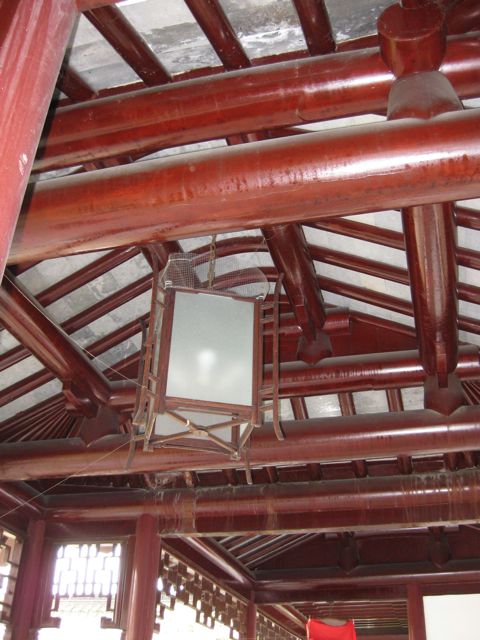 |
| There are no screws in this roof. It's all mortice and tenon. Also, camphor wood! Natural bug repellant! |
 |
| And no Ming garden is complete without a pine tree of longevity. |
Friday, May 6, 2011
Year of the Superhero - Megamind
What do you get when you mix the Hollywood trend towards animated films that aren't solely for kids, the Hollywood trend to have at least 3 superhero movies a year, and the cultural trend to be as postmodern and self-referential as possible?
Megamind. The story of a conniving blue-skinned alien who gets his kicks out of being a supervillain—until he defeats his archnemesis and gains ultimate control over Metro City. Turns out that ultimate control is kind of boring, so Megamind creates a superhero to balance the power vacuum, at which point Things Go Wrong. There is, naturally, a Sassy Reporter Girlfriend as well.
I'm not generally a fan of Will Ferrell movies. His humor tends to fall flat for me, and a number of the plots tend to be … juvenile, let us say. So when I heard he was going to be voicing a supervillain 'hero', I was nervous. Was this going to be another instance of him overacting? Was there going to be a plot, or just superpowered hijinks for two hours? I'd nearly resolved not to go, and then I saw the trailers.
Turns out that Megamind is not only story about a supervillain, and not only a Shrek-like send-up of superhero films, but it's also a commentary on what it means to be a villain and a hero, and a story of redemption. There's a clear message that "There's good in all of us."
Let's dissect it, shall we?
Megamind and Metro Man are sent to Earth by alien parents from planets that are being destroyed. Metro Man ends up in a wealthy, all-American family. Megamind ends up raised by convicts. They wind up in the same school, where Metro Man bullies Megamind and Their Rivalry Is Born™. Megamind turns to a life of crime because so many other avenues are closed to him because his creativity gets him into trouble and nobody cares for his skin color.
So far, so standard, except notice that Megamind is not only a geek, but he's also a person of color? It's easy to say, "Yes, I get it, Hollywood. He's a bad guy because he isn't white, and he's kind of weird to boot." But then Megamind has a change of heart, and he gets the girl, and at the end of the film, he's kind of a hero. It's a message of hope, and a surprisingly enlightened character arc. The dark-skinned weirdo can be a good person, accepted into society? Who knew?!
The Rivalry™ is very much a game for our villain and hero. It's sparring matches, competition, a challenge. When Megamind defeats Metro Man, he's excited, yes, but there's also a big undertone of "That actually worked? I actually won? How is that possible?" It's bittersweet. Megamind goes on his crime spree anyway, but it quickly gets boring. He realizes that the fights were never about control, they were about competition, and he needs someone to compete with again. Unfortunately, he ends up giving powers to a schlub, and the second act of the film kicks off.
So, this schlub? He reacts to superpowers in a pretty realistic manner. His 'space parents', Megamind and Minion the sidekick, train him up, drill him on justice, and give him a snazzy costume, and he's cool with that because he's so in awe of having superpowers and being someone for the first time in his life. But then he realizes that it's so much easier to have fame and wealth if you steal it. Yep, he turns into a supervillain himself, right on the eve of the unveiling Megamind's planned for him. This leads to a genuinely nerve-wracking climactic fight scene, even if kooky weapons and kid-targetted hijinks show up as well. Titan, the superhero-villain, is just too powerful, and too corrupted by that power. Also, he's decided it's his right to have Sassy Reporter Girlfriend Roxie as his girlfriend, when Megamind's genuinely in love with her. One more reason for Megamind to defeat him.
It is real love, by the way, between Roxie and Megamind, not the bog-standard lust-as-love, we're-adding-a-girl-because-we-need-a-love-interest Hollywood model. They flirt. They commiserate. They like the same things. They have great conversations. They share a sense of humor. They team up to 'take down' Megamind. They're cute, and we get to watch them fall in love on screen. And then Roxie finds out that the guy she's hooked up with is really Megamind in disguise, and there's a horrible break-up which reinforces Megamind's opinion of himself as the hard-done-by geek/villain who will never get the girl. Luckily, Roxie sees the light during the climax and ends up fighting alongside Megamind, rather than playing damsel-in-distress the whole time. Girl power is go! Contrast this with Lois Lane, who may be tough but stays on the edges of fights, and who's more in like or lust with Superman than she's in love with him, in most forms of canon.
It's also notable that Metro Man is not the antagonist, the way Captain Hammer is Doctor Horrible's. The antagonist of the story is … Megamind's hubris, I guess, and to an extent his lack of confidence. Metro Man's there to be a foil, to be the nominal superhero in a story about villains, and to make a comment about power and fame not being everything—also a cool, positive thing for a Hollywood film to be saying.
Megamind's a surprisingly intelligent superhero film, in other words, right up there with The Incredibles. It has a lot to say about heroism, surface judgements, and human nature. It has positive messages that hit adults as well as kids. It's smart, funny, and original. Obviously, I really liked it, and I'm betting most superhero fans will too.
Megamind. The story of a conniving blue-skinned alien who gets his kicks out of being a supervillain—until he defeats his archnemesis and gains ultimate control over Metro City. Turns out that ultimate control is kind of boring, so Megamind creates a superhero to balance the power vacuum, at which point Things Go Wrong. There is, naturally, a Sassy Reporter Girlfriend as well.
SPOILERS BELOW
Turns out that Megamind is not only story about a supervillain, and not only a Shrek-like send-up of superhero films, but it's also a commentary on what it means to be a villain and a hero, and a story of redemption. There's a clear message that "There's good in all of us."
Let's dissect it, shall we?
Megamind and Metro Man are sent to Earth by alien parents from planets that are being destroyed. Metro Man ends up in a wealthy, all-American family. Megamind ends up raised by convicts. They wind up in the same school, where Metro Man bullies Megamind and Their Rivalry Is Born™. Megamind turns to a life of crime because so many other avenues are closed to him because his creativity gets him into trouble and nobody cares for his skin color.
So far, so standard, except notice that Megamind is not only a geek, but he's also a person of color? It's easy to say, "Yes, I get it, Hollywood. He's a bad guy because he isn't white, and he's kind of weird to boot." But then Megamind has a change of heart, and he gets the girl, and at the end of the film, he's kind of a hero. It's a message of hope, and a surprisingly enlightened character arc. The dark-skinned weirdo can be a good person, accepted into society? Who knew?!
The Rivalry™ is very much a game for our villain and hero. It's sparring matches, competition, a challenge. When Megamind defeats Metro Man, he's excited, yes, but there's also a big undertone of "That actually worked? I actually won? How is that possible?" It's bittersweet. Megamind goes on his crime spree anyway, but it quickly gets boring. He realizes that the fights were never about control, they were about competition, and he needs someone to compete with again. Unfortunately, he ends up giving powers to a schlub, and the second act of the film kicks off.
So, this schlub? He reacts to superpowers in a pretty realistic manner. His 'space parents', Megamind and Minion the sidekick, train him up, drill him on justice, and give him a snazzy costume, and he's cool with that because he's so in awe of having superpowers and being someone for the first time in his life. But then he realizes that it's so much easier to have fame and wealth if you steal it. Yep, he turns into a supervillain himself, right on the eve of the unveiling Megamind's planned for him. This leads to a genuinely nerve-wracking climactic fight scene, even if kooky weapons and kid-targetted hijinks show up as well. Titan, the superhero-villain, is just too powerful, and too corrupted by that power. Also, he's decided it's his right to have Sassy Reporter Girlfriend Roxie as his girlfriend, when Megamind's genuinely in love with her. One more reason for Megamind to defeat him.
It is real love, by the way, between Roxie and Megamind, not the bog-standard lust-as-love, we're-adding-a-girl-because-we-need-a-love-interest Hollywood model. They flirt. They commiserate. They like the same things. They have great conversations. They share a sense of humor. They team up to 'take down' Megamind. They're cute, and we get to watch them fall in love on screen. And then Roxie finds out that the guy she's hooked up with is really Megamind in disguise, and there's a horrible break-up which reinforces Megamind's opinion of himself as the hard-done-by geek/villain who will never get the girl. Luckily, Roxie sees the light during the climax and ends up fighting alongside Megamind, rather than playing damsel-in-distress the whole time. Girl power is go! Contrast this with Lois Lane, who may be tough but stays on the edges of fights, and who's more in like or lust with Superman than she's in love with him, in most forms of canon.
It's also notable that Metro Man is not the antagonist, the way Captain Hammer is Doctor Horrible's. The antagonist of the story is … Megamind's hubris, I guess, and to an extent his lack of confidence. Metro Man's there to be a foil, to be the nominal superhero in a story about villains, and to make a comment about power and fame not being everything—also a cool, positive thing for a Hollywood film to be saying.
Megamind's a surprisingly intelligent superhero film, in other words, right up there with The Incredibles. It has a lot to say about heroism, surface judgements, and human nature. It has positive messages that hit adults as well as kids. It's smart, funny, and original. Obviously, I really liked it, and I'm betting most superhero fans will too.
Monday, April 25, 2011
Year of the Superhero - X-Men Trilogy
Over the last couple weeks, I've rewatched the X-Men trilogy. Not the Wolverine movie, which I've heard is horrible and am therefore avoiding. I like Hugh Jackman, but I don't like him that much. All three movies have been fun and gave me lots of action scenes, mutant powers, and, erm, Hugh Jackman—but they're flawed, too, especially with regards to pacing. Like many adaptations with huge fan followings, the X-Men films try to stick as much canon, wow factor, and fan service into the story as possible, to the detriment of the plot. I don't mind too much because I don't watch summer blockbuster movies expecting Oscar-worthy performances and fabulous scripts. I expect Oscar-worthy special effects and sound editing, if anything, and X-Men does deliver that.
First of all, the superpowers. Might as well get that out of the way first, right? One of the things that draws me to the X-Men is the incredible range of powers that seem to be possible. As long as I don't think how they're possible in some cases, I'm good. (Perhaps it's like in Wild Cards, where the powers are psi-based?) The sheer range of powers intrigues me. There are people who can manipulate elements, people who can control objects, people who read minds, people whose appearances have changed, people who heal quickly or teleport, people who do combinations of all these things. It's easy to imagine yourself as a mutant. What power would you get?
Of course, there are downsides to mutation. There's the gay rights and anti-anti-Semitism parallels, of course, since mutants are feared, persecuted, and second-class citizens. They play up the anti-Semitic stuff in the movies, though I don't know if that's the same in the comics. Magneto's a Holocaust survivor regardless of medium, however. But the powers themselves can provide downsides, like with Cyclops, who can't open his eyes without blasting everything to pieces, unless he has his glasses. In other superhero canons, superpowers cause angst of the 'oh, if only I could tell my loved ones' variety, and the occasional accident. The powers in X-Men seem more realistic, or at least more thought-out, because they're so often a double-edged sword.
Quick aside: When I originally watched the first X-Men film, I didn't understand why it started in Auschwitz. I was even dense enough not to realize that the screaming Jewish boy was Ian McKellan. But now that I'm older and aware of the anti-anti-Semitic messages of X-Men, it makes sense. Starting in 1940s Poland sets the stage for not only the one movie, but the whole series.
Another thing that makes X-Men, or at least the films, feel more realistic to me is the exploration of the world. The first movie's about people trying to thwart a terrorist threat. The second's about the same people trying to stop a military operation to destroy mutantkind entirely. The third's about the fallout from a 'mutant cure' announcement. Whereas Batman Begins touched on issues of politics and policing, and the Spider-Man trilogy is about Peter Parker fighting bad guys with media persecution, X-Men actually goes for political plot lines and a more international scope. Notably, there are Canadians, Brits, and Germans as well as Americans in the X-Men team.
I noticed something else for the first time during this rewatch. One level the films are about mutants as a whole, illustrated by the ensemble cast and the 'few fighting for the rights of many' plots, true. But on another level, they're about Wolverine and his quest for identity. He's the rough, wild man who's brought to Xavier's school with no memories, and who's set on the path to find them. He falls in love. He saves Rogue at the end of the first movie. He finds out his origins in X2, and then refuses to learn details. He goes off alone to find Jean in the third film, wanting to save her. For someone who's verging on anti-hero at the start of the trilogy, he certainly ends up rescuing people and acting heroic a lot. And yes, I realize that the films have to have a more concrete protagonist even with an obviously ensemble cast and they picked Wolverine because hey, Hugh Jackman. I just find it interesting that he's got a trilogy-long arc, instead of being dropped after the first movie in favor of a different protagonist*.
I mentioned in my opening that the in-jokes and references to X-Men canon kind of detract from the plot. There wasn't much reason to insert Angel into the third film, for instance, and it kind of amused me that although Kitty Pride was in the other two films, she suddenly became a main character in X-Men: The Last Stand. But seeing those characters—and Beast, and Nightcrawler—was fun, and the scriptwriters did a good job of working the new characters and the fan service fighting into the plot without making the movie too clunky. Kudos to them for that. I also enjoyed seeing the Easter egg-type references, with Hank McCoy and Moira McTaggert appearing on TV screens, and birth names of mutants appearing on a government database. So really, not complaining too much. The fan service works for fans, because we kind of expect that it's going to be there (and Wolverine fighting people's fun). I can't comment on whether it works for non-fans.
You'll notice a trend as this series of posts continues. I'm much more a Marvel girl than I am a DC girl. I prefer Spider-Man, X-Men, Ironman, even the Fantastic Four to a degree, to Superman, Batman, and Wonder Woman. Marvel's more grey and complex, I think, and as I've mentioned here and in the Spider-Man review, there's a greater air of realism. And, as with Spider-Man, I'm going to be tracking down X-Men comics at some point too. They look to be even more fun than the movies.
* As I would expect Hollywood to do.
Wednesday, April 13, 2011
Year of the Superhero - Ghosts of Manhattan

George Mann's Ghosts of Manhattan is billed as a steampunk superhero novel, which is how it found its way onto my reading list. I like steampunk. I like superheroes. A mix of the two sounded great! And then I cracked the book open last week to discover that not only is there a steampunk superhero, but he's a steampunk Batman. He shares the attitude, the protectiveness, part of a costume, the secret identity type, the propensity for wanton destruction and weaponry. The story itself revolves around mobsters and staged murders and a mysterious mob boss, and features a straight-cop detective along with the Ghost. It's fun, it's full of action, it reads quickly. So, y'know, all good there.
Unfortunately, I've got more quibbles for this book than I have for others. Mostly this is a factor of my reading tastes, I think. I'm used to stories that have a bit more than just the action plot, be it social commentary, character development, side plots, or whatever. I'm especially used to steampunk novels (Dream of Perpetual Motion, Boneshaker, Difference Engine) that have strong social undertones, rather than the muted commentary Ghosts of Manhattan does. The former have a lot to say about how technology's altering society for the worse. Ghosts of Manhattan talks about organized crime and people drifting through life without a purpose, which strikes me as a 1920s thing rather than a steampunk thing. The rich of New York were constantly partying in our reality too.
Anyway, we're not talking about steampunk here, we're talking about superheroes. (Though can I say, the steampunk weapons, devices, and vehicles in Ghosts? Awesome.) The Ghost has the hard-boiled, cynical vigilante thing down, though it's never quite explained why he feels the need to do dress up and fight people. Yes, protect the city. Yes, organized crime is bad. Yes, traumatized WWI vet. But I feel there should be something a little more. However, he's very good at getting the job done and the backstory would probably weigh the book down a little, so I'm not quibbling a lot. Also not quibbling about the random mystical stuff that crops up here and there, because I'm not sure it would be steampunk without at least a little random mystical stuff.
I had a tough time enjoying the characters too, but again that's my fault, not George Mann's. Mann's characters are fully realized, if a little devoid of probably-unnecessary backstory. I just like a little more snark in my MCs, and the book before Ghosts was Cloud Atlas, one of those books that's so good it's guaranteed to spoil whatever comes after it.
So: cool hero, cool story, cool inventions. I read the book quickly, or at least it felt like I did. If you like action stories, you'll like this. The fights are fantastic! Ghosts is a little weak on the mystery elements—the clues come a little too conveniently for my liking—but I did think I had the villain pegged several times when it was somebody else entirely. It's largely a story of archetypes, on one level, which works because so many superheroes and villains are archetypes. The Ghost feels like he could've come from any of the early comic books, and that's certainly a good thing.
I know I've complained about Ghosts here, but I definitely enjoyed reading it and don't regret the time it took me to do so. It's certainly not a bad novel. If you're interested in reading it, do so. If you're not, well, don't.
Friday, April 8, 2011
Superhero Round-Up
I know I probably shouldn't do two superhero posts in a week, because predictability and ruts are bad things, but I had to get up early to let in the guy who's currently sanding drywall mud off my walls* so I can't quite brain enough to write an essay this morning. Luckily, some awesome superhero-related stuff has shown up on the internet lately, so I can spam you with it. Bwahahaha! *cough*
First of all, everyone needs to read this essay on why Dr. Horrible as a retelling of Spider-Man. It's about a thousand times better than my post on Dr. Horrible (or, for that matter, Spider-Man), and is pretty much genius.
Second, clips from Thor!
And footage from Green Lantern, courtesy of WonderCon!
Now, I was going to watch these movies anyway. I know nothing about Green Lantern at all, except that there's a ring and lots of different races, and well, Kenneth Branagh plus Norse mythology plus Marvel superheroes is bound to be epic. But seeing the new footage of both films makes me want to see them more. Especially the stuff from Green Lantern, because it looks like it'll be more than an origin story—there'll be bits of space opera in there too. The CGI looks decent. I hope it holds up on the big screen.
Green Lantern and Thor are definitely the superhero movies I want to see most this summer. I'll be going to Captain America too because, like Green Lantern, I know next to nothing about it. (It's set in World War Two and the guy has a famous shield that's cameoed in Iron Man II.) X-Men: First Class I'm waiting on more footage and trailers before making up my mind. On one hand, it looks reasonably forgettable. On the other, it features new heroes and looks better than Wolverine, at least. Also, James McAvoy is in it. But there are so many other films coming out, I don't know whether I want to shell out for this one too.
Anyone have other superhero stuff they want to share? Which superhero movies are you looking forward to this summer?
* long story
Subscribe to:
Posts (Atom)