Pages

Friday, May 25, 2012

England, Part Two

The Victoria and Albert Museum! Art and design through the centuries! Highly recommended! I spent the whole day there, just about, and by the time I was done, my brain was ready to melt, I'd absorbed so much information. As I mentioned in the last post, a lot of the photos I took here were blurry. Low light levels and no flash will do that, unfortunately. I've left most of the blurred ones out because I can't show you all the cool bits of detail if they're not there, but also because 100+ photos is probably too many. I'm pushing it as it is.

The earliest street lighting was not gas, but coils of burning rope, in the Tudor era:


Famous statues!


A late-medieval German Madonna and Child:


A medieval cowl, photographed for the embroidery:


Early Korean bronze mirrors (polished side facing wall):


Chinese ritual drinking vessels, Bronze Age on left, 19th-century (?) on right. Photographed out of delight at how much the design didn't change.

An early pottery horse, from China:

A comparatively recent pottery camel, photographed for his expression:


Two suits of samurai armor


A plaster cast of Trajan's Column, in two parts:


And in close-up:


Various Scandinavian works, mostly from the Viking period:


One of four Tudor flag holders (there's a proper name for them, but I can't remember). This is the one that caught my eye first.


A circle of flattened brass instruments, hanging from the ceiling.


You know those cardboard cutouts you can get of your favourite actor or movie character? Apparently they were cool in the 18th-century too.


And then my camera battery announced that it was seriously low and would like to be recharged, please, so I stopped taking photos at the V&A and went to the Science Museum around the corner, which had…

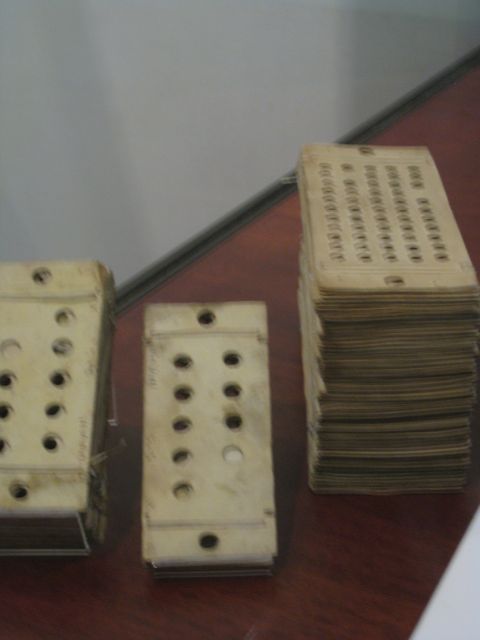
Difference Engines!


Among the many, many things I didn't photograph at the V&A were an impressive jewelry collection; an exquisite collection of jeweled snuff boxes; all sorts of Tudor and Jacobean artifacts, from clothes and cushions to furniture and weapons; many more statues and religious artifacts; a timeline of Japanese pottery; and an Islamic exhibit I skipped because, as I said, my brain was melting. I didn't see anything else in the Science Museum because there wasn't time and not much else looked interesting anyway.

By the time I was done with these two museums, I'd decided that I wanted nothing more than to sit down for the next century, and that I'd seen so many artifacts that going to the British Museum the next day would be overkill. Unfortunately, because I did really want to see the Anglo-Saxon stuff and I think they have bog bodies? Maybe? Ah well, next time. Incentive to go back. :)

Part Three (and Last) will largely consist of pictures of Westminster Abbey and the Houses of Parliment. You've been warned.

Thursday, May 24, 2012

England, Part One

I got back from England a couple days ago. It was kind of a spur of the moment trip, which meant a lot of scrambling around the two weeks beforehand, getting everything in place, and therefore not a whole lot of blogging. So, if you've been wondering why I haven't posted much in the last while, that's the big reason. I'd have said something about the trip, except you're not really supposed to tell the internet about your travel plans. 

But I can share pictures of the trip after the fact, so here goes. Easy blog posts ahoy!

Here's the Dutch coast, about half an hour after my transfer in Amsterdam: 


And here's a mostly-Victorian graveyard in Manchester…


… that contained an intriguing gravestone. I'm voting time travel.


Make that two intriguing gravestones. I'm not sure what the symbolism means here.


I was in Manchester for my sister's wedding. I'd post pictures, except she'd probably kill me. It was good, though. Nothing to complain about and everything to rejoice over.

The day after the wedding, I hopped a train for London. I had big plans to stare out the train window and absorb the many variants of England as they rushed past me, but it turns out that the only variant of England along the rail lines is the farmland-and-stone-village one out of James Herriot and Beatrix Potter. That got kind of dull, so I stuck my nose in a book pretty quickly. Sixty-One Nails is absolutely fantastic British urban fantasy—it's blurbed as "Neverwhere for the next generation" and they're right—and I completely struck out finding the sequel in the UK. It's not out in North America yet.

Anyway, London, Day One!

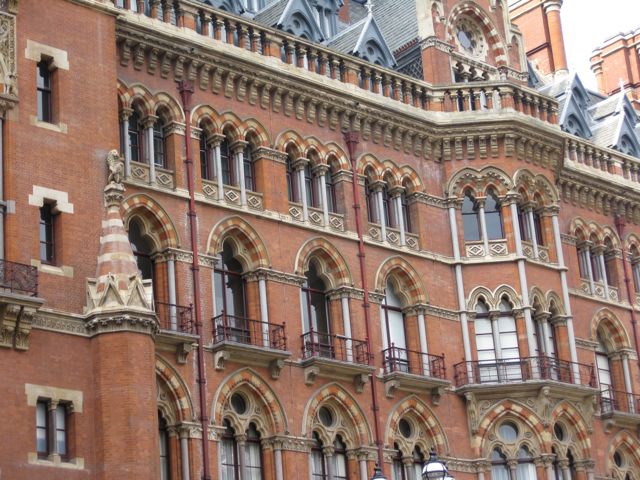
Saint Pancras Station, on my way to discovering the British Library wouldn't allow my duffel bag inside and I'd have to come back a different day.


King's Cross was on the other side of the street, but I didn't get a picture of Platform 9 3/4. I didn't want to push through the crowds to find out if I had to buy a ticket or not.

After dropping my bags at the hostel, I headed downtown again. I hit The Clink museum first, which was interesting but not nearly as much as I'd hoped. Would be good for kids who didn't know much about the early British prison system, but didn't have a lot of advanced material or artifacts to keep a knowledgeable adult engaged. But! in the same neighbourhood there were:

the ruins of Winchester Palace (1100s),


Southwark Cathedral,

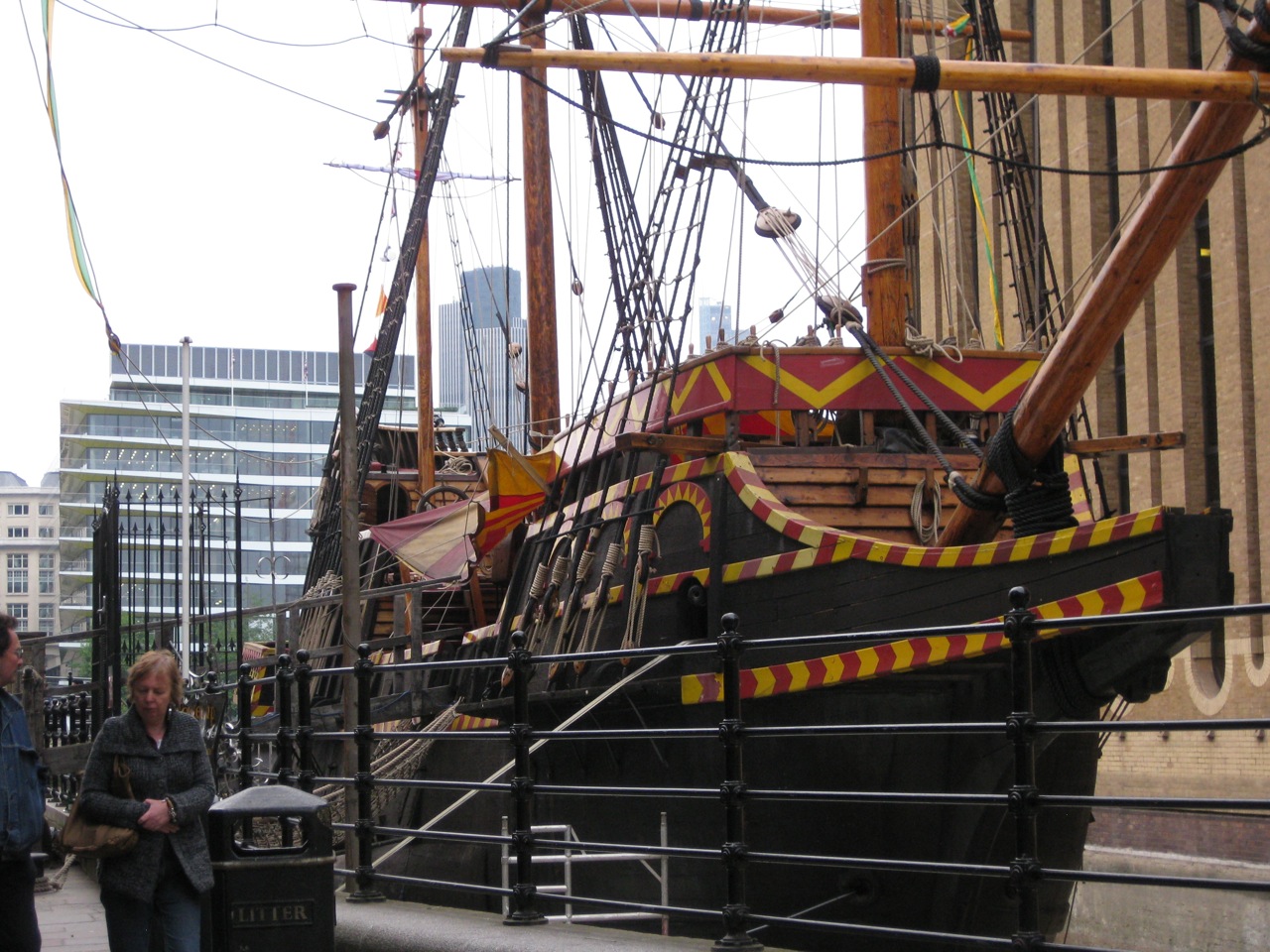
and the Golden Hind (replica):


There are lots more pictures of Southwark Cathedral, but I thought I'd spare you. :) After that, I crossed a bridge and saw this:


On a building I found a (18th-century?) notice, proving that prosecution signs go back a long way. I can't read the whole of this, unfortunately, but am assuming it's for loitering, because it amuses me to think so.


Also spotted were a church showing damage from the Blitz…


… a baroque water fountain …


… and, of course, St. Paul's.


I've always heard about the beauty, majesty, and perfection of St. Paul's and said, "Ha! No building could live up to that hype! I don't believe it!" Except that this one does. It's flawless and tasteful, in a baroque sort of way, and in the early evening, took my breath away. I have a lot of photos of St. Paul's.

And then my legs were really tired and it was late, so I went to the hostel again.

Next up, the Victoria and Albert museum! In which I went overboard with the camera again and a lot of the photos are blurry!

Monday, May 14, 2012

Great Superhero Read - The Avengers

Hoping to avoid spoilers, but read at your own risk.

The moment The Avengers was announced, I knew I was going to it. A movie with Iron Man, the Hulk, Thor, and Captain America? How could I not? But at the same time, I was a little leery because the film would have a lot of strong, well-loved characters who'd demand screen time and I haven't seen all that many superhero ensemble films-- The Fantastic Four comes to mind, and that was abysmal.

I was glad to hear that Joss Whedon would be helming the film, though. I'm not a massive Whedon fan, but I've enjoyed his work and trust his writing and directing, and I know he's a geek and a fanboy. I figured he'd do the movie and characters justice, if anyone would.

I was torn by the trailers. They did a great job of inspiring confidence that the film would look awesome and treat the characters appropriately, and they were wonderful at conveying the general mood and plot without actually giving details. But at the same time, they had Thor fighting other Avengers, didn't show very much of the Hulk, gave the impression that there wouldn't be much substance (just battles), and had some valid complaints lobbed at it re: the fact that Black Widow has a tiny gun. I also wasn't sure how I felt about not entirely knowing the villain ahead of time.

The movie is and isn't anything like the trailers. We get the awesome battles and the snark, but we also get a tight, thinking-person story that keeps you guessing, and strong and believable character dynamics. It's just as thrilling and inspiring of nerdy glee as you'd expect. The science looked and sounded plausible. One of my bigger worries was that the Avengers would be introduced in a single scene, but I shouldn't have: Whedon spread the characters out so we'd get to know them one by one, and did it in such a way that the introductions worked with the story, rather than feeling forced. There were some excellent gags that had everyone in the theatre laughing. And Whedon even managed to bring out the personalities of lesser Marvel movie-verse characters Hawkeye and Black Widow, and to make me want an origin movie for the two of them. While there wasn't a whole lot of character arc material, there was some, and I definitely like Ruffalo's portrayal of the Hulk (though I haven't seen the other recentish Hulk movies).

One thing I've been noticing more lately is the appearances and agency of women in fiction. I blame the internet. Whedon did a good job, in my unschooled-in-formal-feminist-criticism opinion—that one line that has online feminist fandom talking aside. Natasha Romanov/Black Widow comes off as a realistic woman, with friends and fears and a fantastic ability to beat people up. She has action and agency and isn't a sexual object. Maria Hill is equally awesome, though we get less of her personality and more of her second-in-commandness. I don't remember anyone treating her differently because of her sex. And there are bit parts that could easily have gone to men, but went to women, which was nice to see. The Avengers doesn't pass the Bechdel Test, but that's not the be-all-and-end-all of feminist critique for me.

A couple quibbles: Fury was great, but largely in the background (which is probably fine, it's The Avengers not Nick Fury). We saw him making decisions and saying they were right, without any proof he could make good calls, but that might've taken away some of the suspense, so that's fine with me in the end too. Still, Fury's an interesting character and I'd like him to look less like a figurehead.

I also felt that Loki was a little out of character with his scheme, but believable enough. I had more trouble with him willingly subordinating himself to another person. Loki definitely makes a good villain, though, and I hope to see more of him in other films. He plays long games and keeps people guessing, and I like that.

Quibbles aside, I really liked the film. Spent-2.5-hours-in-a-theatre-grinning-my-head-off liked the film.Going-to-see-it-a-second-time-on-the-big-screen liked the film, which doesn't happen very often. It's fun, it has action and explosions, it has superheroes and some of my favourite characters to boot, and it has plot! That doesn't strictly follow the origin story model! That I couldn't predict!

Go see it, if you haven't already. Or see it again, if you have.
 

Tuesday, May 8, 2012

The Future is Coming

I haven't blogged in a while. Sorry. Life's doing a bang-up job of getting in the way of things. Also am writing again. Ish. Only a couple scenes from the end of the Part One novella, but I have to do another pass through it to add a mini-narrator and tweak one of the main narrator's voices slightly. And then done, hurray! And I can move to Part Two.

 I have a couple blog posts in the works right now, mainly one of The Dark Knight Returns which I'm still trying to process. A post on The Avengers might come sooner. I'm going to see it tomorrow.

In the meantime, I think my log of neat science has gotten long enough to post. :)


  • We have managed macroscopic teleportation!
  • We have improved our chances of having ubiquitous holograms this decade!
  • And two other videos that I love. The first is a whole new breed of robot, and I guess the second one is too. Self-driving cars are robots as far as I'm concerned. 


And that's all from me for now. Science is wonderful. The future is wonderful. I can't wait.

Tuesday, April 10, 2012

How Not to Write a Cop Show (or, a review of Alcatraz)

As with most of my media-related rants, this post will contain spoilers. For multiple shows, possibly, but mostly for Alcatraz. Consider yourselves warned.

I've mentioned before on this blog that I'm a sucker for cop shows. I don't watch them all, but almost all I watch has some version of Case Of The Week in it. I'm especially a sucker for the shows with some science fiction or fantasy element -- Grimm, Supernatural, Castle, Bones, Alcatraz... Except that Alcatraz kind of lagged for me and I'm not interested enough to continue with the second season when it airs. Which is a shame, because the ideas in the show have potential.

Alcatraz, in case you don't know, revolves around a team of people, ostensibly part of the FBI, who travel around the San Francisco area capturing Alcatraz inmates who've been transported mysteriously forward through time. There's the Grizzled Senior Agent, the Young Eager Detective, the Geeky Comedic Sidekick, and a supporting cast of friends, relatives, and people connected to 1960s Alcatraz. Because it's written by people who wrote LOST, every episode ends with a twist that adds to the greater mystery and is meant to keep you guessing for a couple episodes, when they'll mostly resolve it and add something else in its place. Each inmate gets 1960s-era backstory that also serves to heighten the mystery, as does the fact that the Grizzled Agent is very blatantly Keeping Secrets. It's competently written, decently acted, and kept me coming back each episode.

Unfortunately, I came back largely in the hopes that it would get better. Competent is fine, but I was hoping for great, especially with the time travel and mystery thrown in. It could've moved faster. It could've been tenser and ratcheted the stakes past "unsettling" to "we're all going to die". (Presumably that'll come when we find out why the inmates are jumping forward.) It could've had characters that don't feel flat or like they're just going through the motions. About halfway through the season I decided that all the hints were going to give us an explosive finale, and from then on I watched mainly so I'd have all the clues when it was time for them to fall into place. I did not, sadly, get an explosive finale.

The slight flatness of the characters and writing, and the pedestrian nature of the episodes, which have the barest amount of continuity possible, are my main beefs with Grimm and Haven too. Grimm I'm sticking with because it's just cool enough to still hold my interest (and the finale's a few episodes away still), but Haven I quit on partway through the second season. I just didn't care about what happened to the characters anymore.

So here's what I'd like to do, if given carte blanche to reboot Alcatraz:

1. Make the characters more interesting - Characters should have more than one trait or habit to distinguish them from everyone else who shares their trope. A love of comics or the ability to quote philosophy does not an interesting person make. I want to see what scares them, what excites them, what drives them, and I don't want the feeling that the actors are just reading lines.

Booth, the FBI agent on Bones, is a Catholic football fan and ex-sniper who solves crimes creatively and doesn't quite understand the scientist mindset. Hauser, the FBI agent on Alcatraz, is an ex-Alcatraz guard who studied philosophy, fell in love with and lost a psychologist, and has become a grizzled, cranky old man. 

Interesting, complex characters not only get me emotionally invested in their stories, but make the story less predictable because I'm not always sure how they'll react in any given situation.

2. Speed up the feed of clues or the importance of them - I am perfectly happy to know that Mysterious Things Are Happening and that I may have to wait the better part of a TV season before I know the answers. I want the twists to shake my world and make me think, not say "eh, I wonder where they're going". I want to be involved. 

Supernatural does this well. We'll generally get a small clue or twist every episode (the demons want x because y, they want y so they can z). Every few episodes, the twist will be something massive, like a character being a double agent or the demons' plans being almost the opposite of what anyone thought. The twists have a strong connecting thread, they tend to follow logically from each other, and when the big ones happen, they truly do change everything. And if Supernatural does one thing well, it's cliffhangers. Man, are they good at cliffhangers.

In Alcatraz, the clues were scattered and a lot weaker. One week we'd discover a mysterious key. The next week, we'd see the warden playing favourites for unknown reasons. The week after that, the inmate-of-the-week would say "They told me to" as an explanation for his crime spree. The clues only have tangential relationships with the rest of the episode they're embedded in, and only slightly more attached to the season arc. When Supernatural gives a twist, we know how it'll affect the season from thereon out and I start squealing in my chair. When Alcatraz gives one, it's simply a fact and doesn't noticeably change the characters' behaviour. Or mine. 

What I'd like to have seen from Alcatraz is more clues, faster. Tell us, in the same episode, that there's a mysterious key, the warden is playing favourites, and They are telling criminals to do things. In the next episode, give us more information about all three elements. Let us catch a glimpse of the They, even if it's by way of phone call. Show us in 1960 something about the key that 2012 won't find out for another few episodes. Around mid-season, finally use the keys or figure out the They, or even find out how the inmates are jumping through time. End the season with a revelation about what Their end goal is, and make us feel like the characters are against insurmountable odds, that they might never win. I wouldn't reveal the reason behind every clue, but I'd follow through often enough that viewers wouldn't grow disappointed.

I get the feeling that the writers were used to LOST, where they could spin out endless clues without really knowing where the series was going to end, which didn't teach them much about follow-through or coherence.

3. Increase the tension and drama - There's a whole subplot in Alcatraz about how Young Detective's "deceased" inmate relative is somehow key to the mystery. She apparently really wants to find out why, and to find him so she can arrest him, because we see her pouring over case files and saying things like, "I have to find him" to the rest of the cast. Hauser, the FBI agent, also wants to find this guy, and he says things like, "I want to find him. I have the feeling he's important" to the rest of the cast. But with neither of them did I ever feel that they meant it because they were curiously short of emotion in those scenes. Nor did I feel the criminal mcguffin was a genuine threat to anything. He popped up occasionally but very rarely did anything criminal. I'd make him more prominent, so that when the detective and agent finally track him down, it'll actually be a life-or-death sort of thing. And I'd ramp up the threat level of the other inmates too, on a whole. With some cop shows, I still worry about the characters and that they might not catch the guy. Not so much with Alcatraz.

There are other things I'd change re: tension. The detective and sidekick know the agent's withholding info, but apart from a couple "Please tell us" moments and one minor bit of blackmail over the course of an episode, they go along with it. I'd like them to bully the agent more and finally get him to cave. Or to hack into his systems or break into his house and get the information. Yes, there'd be fallout over the next couple episodes, but interpersonal conflict on TV is fun. And the sidekick clearly has problems adjusting to police work because he's a civilian and a pretty pacifist one at that. He has a hard time with dead bodies. He has a harder time shooting people. We see him dealing with that a little, but I'd like to see that a lot more.

Basically, I'd put the characters under real pressure and see how they react, rather than making the pressures pretty mundane and solvable, because nothing's revealed by giving them things they can deal with.

4. Take risks - I'd hurt protagonists. I'd hurt and kidnap the protagonists' friends. I'd write twists that would make viewers scream at the TV because "HOW ARE THEY COMING BACK FROM THAT?" Castle, which is generally pretty tame and family-friendly, has on at least one occasion "killed" characters at the end of an episode. Supernatural did a whole season where angels were the bad guys. Alcatraz hasn't done anything politically risky or which could have lost them viewers (apart from the writing quality). They haven't even done the 180° shift of bad guy motivation that Supernatural does. It's all basic procedural stuff—there's a bad guy, we have to stop him, we don't know what he's after, we know what he's after, we manage to track him, we put him in handcuffs at the 50-minute mark. Very little deviation, no two-part episodes, nothing.

5. Give the geeky sidekick more story - My favourite part of Alcatraz, probably not surprisingly, is the geeky comic-loving sidekick with the heart of gold. He's by far the most developed character in the show, because we have a good sense of what his family's like, what he likes, what his hobbies are. He cracks jokes but is also the sympathetic ear and very loyal. He even gets the romance subplot! Because he's so rounded, I feel like I know him so enjoy the scenes he's in and root for him. And, as I mentioned above, he's got the hardest time of all the main cast because of all the violence (and because something Bad happened to him when he was a kid). There's an emotional journey! He has to deal with trauma! His personality's going to change! I was to see that!

Plus, you know, I have a fondness for geeky guys. :) But mainly I want to see more of him because he makes the show interesting.

So there you go. If I were in charge of writing Alcatraz, I'd improve the characterizations, make the season arc move further and faster, make sure there was tension to drive the story along on a couple levels, take risks with the storyline to give it further punch, and put more of the geek dude in. If given free reign to tackle Haven or Grimm, I'd do much the same because those shows also suffer from somewhat weak writing. I may even do a post like this for Grimm after the finale. I have Opinions and must share them.

A common piece of writing advice I see is to read a lot, to absorb and analyse how writers put their stories together, so that when it comes time to write your own stuff, you'll have a larger toolkit to play with. This is absolutely true. But I also think that film media can teach a lot about how to tell stories, because the shows that get watched and renewed (or movies that make #1) are obviously doing something right, and the shows and movies without a lot of viewers, or a lot of disgruntled viewers, are doing something wrong.* Being able to analyse what TV does wrong isn't going to sort out every prose writing problem you have, but it does help with the broad strokes, I think. Dialogue, relatable characters, connection with audience, ways to keep the audience sucked in… those are all universal to storytelling.

*Not that the popular shows are perfect, by any means. I can point to all kinds of weak bits in Supernatural. Often a good hook is enough to keep a show on air.

Monday, March 12, 2012

Great Superhero Read - Powers, Vol. 1

I first heard about Powers about a year ago, when it was optioned for TV. It looked like a cool series and I'd heard the author, Brian Michael Bendis, was fantastic, so I did some poking around for reviews then put it on my wishlist. I got the first omnibus for Christmas. I read it a month ago. I liked it enough to keep reading the series when the mood strikes me, but not quite enough to buy more volumes. This may not be the same for all readers, because I'm a) picky and b) cheap, and because this is without question a well-written story.

Powers Vol. 1 ("Who Killed Retro Girl?") is an enjoyable police procedural done in the noir vein. There's lots of swearing, lots of "telling it like it is", and lots of shadows. Someone's killed Retro Girl at an elementary school, and veteran Det. Christian Walker and newly-transferred Det. Deena Pilgrim, of the homicide squad for superheroes, are put on the case. The detecting itself will be familiar to anyone who watches crime dramas--they talk to superheroic contacts, they rule out a couple suspects, they're at wits' end, they have an epiphany--but I'm fine with that for two reasons.
  1. This is the first volume and storyline of a serial comic. It's meant more to establish world and characters than to provide a complex story, and it definitely accomplishes the former.
  2. I still found the story well-written and captivating (except for one thing, but I'll get to that).
The characters were realistic, engaging, and not candy-coated. I haven't read a lot of superhero comics, but in just about every one I have, I've always felt I was reading about Spider-Man or Superman or the Comedian -- characters, archetypes, slightly flat for all they have complexity and Issues. The characters in Powers, on the other hand, come off as people, flawed, scared, and hiding things. They sucked me into the story and didn't lose me for a minute. Even the secondary cast feels real, though they naturally get more archetypical the less screen time they're given.

The world is a little less engaging and realized than the cast, but never enough to lose me. In this volume, it's pretty much the backdrop to the characters and the mystery, though we're given tantalizing hints about the history, characters, power balance, and so on. Think of it like the pilot episode of a TV show, unintroduced secondary characters and all. Unfortunately, I think Bendis tried to put too much into this first book, because there are points where it feels like he's glossing over info and name-checking characters. I'd have liked for him to have slowed down a bit.

The world-building issues aren't a big deal, though. I've read books that are far worse on that count. My biggest problem with Powers is that the solution to the mystery comes out of nowhere. The murderer isn't seeded throughout the story like I've come to expect from mysteries. Maybe leaving him out was part of the realism? But it left me feeling vaguely disappointed and is one of the reasons why I'm not going to be buying Volume 2.

Long story short: Enjoyed the story, found it well-written in some areas and competent in others, thought it was a good start to the series. The flaws were largely ignorable. I can see why they want to make a TV show of it, because it would be awesome. I hope it leaves development hell.

Tuesday, February 28, 2012

February Science Round-Up

A lot of the science that makes mainstream news is downbeat and gloomy. We're destroying the planet. We're running out of resources. We still can't manage to feed the global population. We may be making progress against cancer and AIDS, but then we might not. Birth control could be illegal this time next year. Luckily, a lot of the scientific research and advances are positive and awesome, to counter the trend. I much prefer the future they show.

On the medicine front, we now have a powerful acoustic microscope sensitive enough to hear microbes, if we can only find a way to make it work outside lab conditions. A British company has designed a gene sequencer in a USB stick, which makes sequencing portal and fast and could open up all kinds of avenues. (They call it MinION, which is adorable.) And we can now use 3D printing to create human tissue. It's only being used for drug testing right now, but hopefully in the near future we'll be able to substantially shorten organ transplant lists.

Continuing with biological news, there's an almost viable microbe that can turn seaweed into biofuel as well as a (natural!) plastic-eating fungus in the Amazon. Scientists can reconstruct sound from brainwaves, which I'll admit is a little scary. We've also germinated seeds from the last ice age, which says some very awesome things about the hardiness of plants.

And shifting to technology, we now have a computer program that paints, which is cool, but not quite as cool as flexible circuitry and a wearable electronics platform. Add those to Google's promised glasses and the following video, and we should be in the Future within the next couple years.


Of course, it's anyone's guess how and when all this stuff will be publicly available, rather than exorbitantly expensive and only owned by the rich. Or whether any of it's going to take off, even. Oh, for a time machine … Someone get on inventing that.

Monday, February 20, 2012

Great Superhero Read - Chronicle

I've been describing Chronicle to people as a found-footage superhero movie. It's "shot" by a teen boy's camcorder and has that wonderfully raw, unscripted documentary style to it. Not that it was unscripted, because it established characters and premise too efficiently for that to be true, but there was never a moment when I dropped out of the conceit and said, "Somebody wrote that line." The style complemented the story nicely and as a result, I think this may be one of the most realistic takes on superheroes I've seen yet.

Most of that realism is credited to the story and acting, of course, rather than the cinematography. Three seniors--a loner who owns the camera, his philosophy-obsessed cousin, and a politician-in-training--go into the woods outside Seattle and find a mysterious Something that gives them all telekinesis. Once they discover their powers, the teens start hanging out and training themselves, then pull a couple typically teenaged pranks on the general public. One of the pranks goes wrong, forcing the teens to give themselves rules like "no power use on living things". But the loner gets more and more upset at how unfair his life is and starts disobeying that rule, and then things get Bad. There are subplots surrounding the loner's family and the teen's social lives (sex and drinking), because hey, realism.

I got sucked into the characters' lives quickly, especially our loner protagonist's. There were genuinely moments when I cried and certainly moments when I was scared for them. If the theatre had been empty or I'd been at home, I may even have yelled at the screen. And what's even better is that I didn't really see the twists coming. I thought the film was going to be superhero story type A, then story type B, and then lkjijkadhdkh. On a rewatch I'd catch a lot more of the hints and stuff, I'm sure, but I was so involved in the story the first time round that I only had a minute or so warning, maybe.

This isn't entirely a black and white, good and evil sort of superhero story either, though there are definitely moments of that. It's hard for me, even a couple days later, to look at any given negative event in the film and say, "that was a bad thing, he's completely in the wrong there", because the characters are all so perfectly teenaged. Can I really say I'd have acted differently in that situation? Can I say that any of the characters is evil, since there are mitigating circumstances at every turn? I can't even look at the most heroic moment and think only good thoughts about it.

Which is not to say that this is a completely dark film. There's hope and humor too. I laughed as often as I cried. I also went into the theatre expecting a slightly shallow story that moved from A to B to C without much underpinning, and got a surprisingly deeper, nuanced story. So yes, one of the best superhero films I've seen, definitely the most realistic, and certainly one I'll recommend to people and keep thinking about.

Tuesday, February 14, 2012

Rules of Magic

It's pretty accepted wisdom these days that if you're going to write a book with magic in, you need to put constraints on what that magic can do or the story won't be interesting. Magic wielders can make problems disappear with a wave of their hand or a well-placed word. You'll get deus ex machinas cropping up on every page. The villain of the piece will be so powerful your heroes don't stand a chance. Readers will expect rules and get frustrated when they can't find any. The story will end on page 10. And so on.

The topic came up briefly in #scifichat on Twitter a couple weeks ago. I might even have raised it myself, I don't remember. I do remember having to clarify what I meant, though, and the act of clarifying go me thinking. For me, magic rules exist on a gradient like so much else in the world of the Writing Process. I also apparently define "constraints" pretty loosely. For me, it's not just about who can do magic or how magic happens or where magic's found. It's kind of a mix of all of that, and a little more. Bear in mind this is from a reader's perspective. I have no doubt that even the looser types of constraints are pretty rigorous from the writer's end.

The loosest constraints on magic are found in books where magic is in the background or where the reader doesn't need a detailed description of how magic works to understand the story. The castle flies, but we don't need to know why or how. The elves in the forest just kind of are. The heroine steps through a doorway and finds herself on another continent. People can cast spells in multiple ways and magic rarely if ever has negative consequences for the caster. Ambient natural magic, the sort that humans don't control, also fits here. It's hard to tell if the writer's created rules or is just working from what feels right, but there's no question the story works.

The next level up from that are magic systems that are nearly identical to the ones listed above, except there are a handful of things magic can't do, or can't do well, or people can't do magic until they're trained. Maybe magic doesn't allow time travel or maybe it doesn't work well on animals. Maybe you get magical training on your parents' knees, or maybe you go to school for it. Magic's still pretty much in the background and the story can almost but not quite be told without it.

Then we start seeing systems where magic can do just about anything, but only certain people can make it work. Maybe they've got fairy blood. Maybe they're wizards. Maybe it's anyone with blue eyes or red hair. I'd rank systems where magic can do anything but involves intricate spellwork or specific conditions at this level too, along with magic that does anything but is hard to control. And systems that involve magical backlash are probably here too—where casting a spell diminishes personal energy or causes pain, and magicians can do anything as long as they can handle the kickback. Making it harder for the characters to do magic makes it harder for them to achieve their goals and I think, though I'm not sure, that this is about where most of the action-oriented fantasies come in.
After the broad application levels, the potential of magic starts narrowing. Maybe different people do different sorts of magic, so the guy's who good with fire is going to suck at or be unable to read the future, and the guy who reads the future can't make a potion to save his life. Maybe magic can only apply to living things, or inorganics, or the elements. Maybe spells end after thirteen hours.

From there, magic systems narrow further by imposing more and more limitations, to the point where blue-eyed, red-headed daughters of seventh sons can only control earth magic under the full moon at midnight if they've had twenty years of training and eaten special herbs beforehand. I think when you get that complicated and make magic almost impossible to do that the fantasy becomes less fun, but maybe that's me. I'd be delighted to be proved wrong.

I think a similar series of gradients probably applies to science fiction. We've got hard science fiction, after all, and various "soft" sci-fis until we hit space operas like Star Wars which can sometimes be classed as fantasy. It's probably even possible to sync the two gradients up and create one that encompasses all of speculative fiction. I am, however, too lazy to do that, but maybe I've inspired you?

Oh, and if anyone has thoughts on this, positive, negative, or simply thoughts, let me know. I like discussions. :)

Wednesday, February 1, 2012

Great Superhero Read - Alphas

Alphas is the first superhero show in the last couple years that I've managed to get into. The Cape was … eh. No Ordinary Family had too many poor reviews and I didn't like what I saw in the trailers. But the concept of Alphas intrigued me, and the characters and writing kept me, and the new season cannot start fast enough.

Alphas is a blend of superhero and crime dramas. There's a team of people, each with an 'alpha' ability, who are assembled by a psychologist and work for the Department of Defense, tracking down other alphas who are (usually) a threat to society. The show's wonderfully morally grey—there are secret and terrible prisons, nobody really knows what the DoD's long term plan for alphas is, and not every alpha-of-the-week is actually a bad guy in the end. The main ensemble knows they're getting progressively more in over their heads and being asked to do things that they're not trained for, especially when it comes to the Big Bad, alpha terrorist group Red Flag.

Alphas is as much about the characters as the crime-of-the-week, though. Everyone's believably flawed and played straight and realistic, not for laughs or as archetypes. They screw up. They have emotional baggage. They get on each others' nerves for the smallest things, and sometimes they lose trust in each other, but at the end of day they're friends. Occasionally the "end of the day" is a couple episodes later, though. This is not a show that wraps up everyone's problems neatly at the end of the hour.

As for the superhero aspects of the show: everyone in the ensemble has powers except for Dr. Rosen, the psychologist and alpha expert. There's a bit of stereotyping going on with who gets what power—the black guy's really strong, the beautiful woman has mind control, the nerd can hack anything with his mind—and the "synethesia" one woman has is not actually synethesia. The powers don't feel over-the-top, just a little beyond what's normal, and there's yet to be a big hero-vs-villain sort of fight that doesn't involve a) teamwork or b) conventional weapons. We're also jumping into these people's lives after they've figured out what they can do, so we see acceptance, not angst. Family members know, characters use powers for everyday things like getting a can of coke out of a machine or avoiding a speeding ticket, and nobody, not even the alphas-of-the-week are defined by their powers.

As you can probably guess, the believability and understated everything is a large part what attracts me to the show. It's a cop show, not a soap opera like Heroes or an homage to comics like The Cape was looking to be, before I stopped watching. (I also like cop shows about as much as I like superheroes. That probably helps.) I'm also caught by the writing, which seems a cut above regular TV fare, and like that the writers aren't afraid to explore the morally grey thing. I've been looking forward to Season Two since it was announced, and no, that cliffhanger in the finale really didn't help.